The operator is authenticated. The role permits the function. The record passes validation. The automated recommendation clears its threshold. Every technical check is green.
And the action may still be unauthorized.
Institutional authority is more specific than access. It connects a person or service to a permitted purpose, subject, scope, time, evidence state, rule version and accountable chain of acceptance. When systems compress that chain into a single permission flag, they can make an action executable without making it defensible.
The design question is therefore larger than “can this account perform this operation?” It is “why is the institution allowing this operation now, and can that answer survive later review?”
Access is necessary. Authority is contextual.
Authentication establishes that a presented identity passed an identity check. Authorization systems usually map that identity or service to roles, attributes and permissions. Those controls are essential. They reduce the set of actors and operations that can reach sensitive functions.
But a standing role often says little about the immediate institutional basis for action. A person may be permitted to approve a category of request without being assigned to this case. A service account may be permitted to update records without being permitted to infer a new status from incomplete evidence. A supervisor may hold broad access while a temporary delegation has expired. A model may generate a recommendation while the policy version used to interpret it is no longer effective.
Authority sits at the intersection of those conditions. It is a bounded claim: an identified actor or service is permitted to perform a named action, on a defined subject, for a legitimate purpose, within a valid interval, under a current rule, using evidence that meets the decision’s standard.
The authority envelope belongs inside the action record.
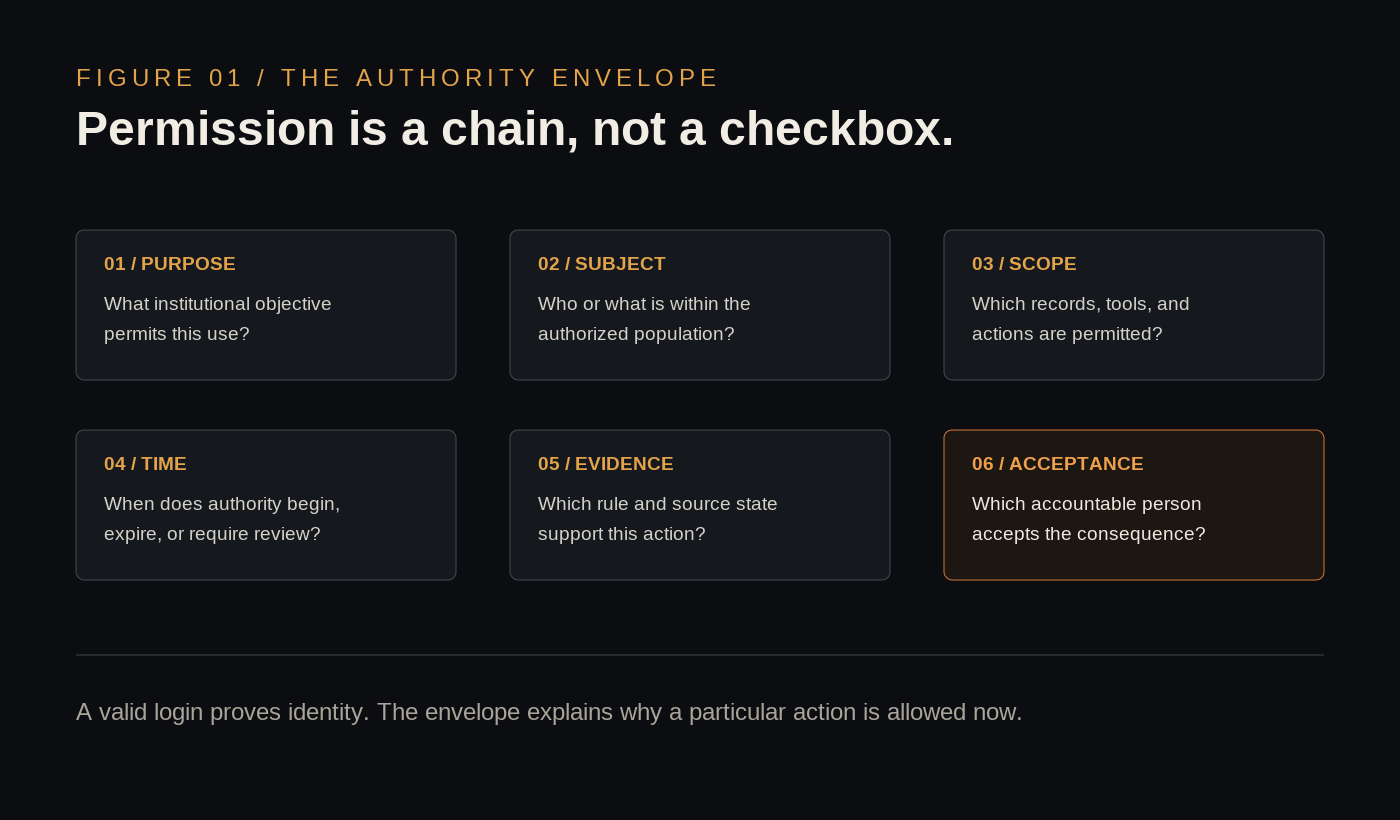
An operational record should preserve more than the final status and the account that clicked a button. It should retain the conditions that made the action acceptable at the moment it occurred. This creates an authority envelope around the action.
Identify the person, service, device or automated component that proposed, reviewed and executed the operation. Delegation should preserve both the delegate and the authority source.
Name the institutional objective that makes the use legitimate. “Operational need” is rarely specific enough. Purpose should be connected to the workflow and permitted use.
Define the case, person, asset, facility, event or record set affected. A role that is valid for one population should not silently expand to another.
Preserve the allowed operation and consequence. Reading, recommending, routing, updating, notifying and closing are different authorities.
Record the effective interval, review point and expiry. Authority that once existed should not become an invisible permanent entitlement.
Connect the action to the evidence snapshot, policy or rule version, threshold and accountable human role that accepted the result.
Governance must become executable without disappearing.
Public governance frameworks describe responsibility and authority as active controls rather than decorative policy language. The NIST AI Risk Management Framework’s Govern function treats governance as a cross-cutting activity, with leadership responsible for policies, processes, roles, responsibilities and delegated authority. NIST’s Risk Management Framework likewise makes authorization a formal decision by a senior accountable official who accepts or rejects defined risk.
The U.S. Government Accountability Office’s Green Book frames internal control around responsibility, delegated authority, accountability, risk tolerance and control activities. The common point is not that every institution should reproduce a federal control structure. It is that responsibility must be assigned, authority must be bounded, and acceptance must be reviewable.
Software often loses that structure when policy becomes a configuration table. A Boolean permission answers whether a function is generally available. It does not preserve the decision context that allowed this instance. If the policy changes, the system may also lose the ability to explain why an earlier action was permitted under the prior version.
A stronger design keeps governance visible at runtime. It can evaluate the policy and still retain the authority basis: policy identifier and version, effective interval, subject and purpose match, evidence state, exception path, delegation chain and accountable acceptance.
A system should not confuse the ability to act with the authority to act.
Execution is a technical state. Authority is an institutional claim that must remain inspectable.
Automation inherits limits. It does not create authority.
An automated component can apply a rule consistently, detect a threshold, assemble evidence or propose a route. It cannot grant itself a broader purpose because the available data makes another action technically possible.
This distinction becomes important when a model or workflow engine produces a confident result. Confidence is not authority. A high probability does not establish that the system was permitted to use the inputs for this purpose, affect this subject, apply this policy version or execute this consequence. Those questions must be answered independently.
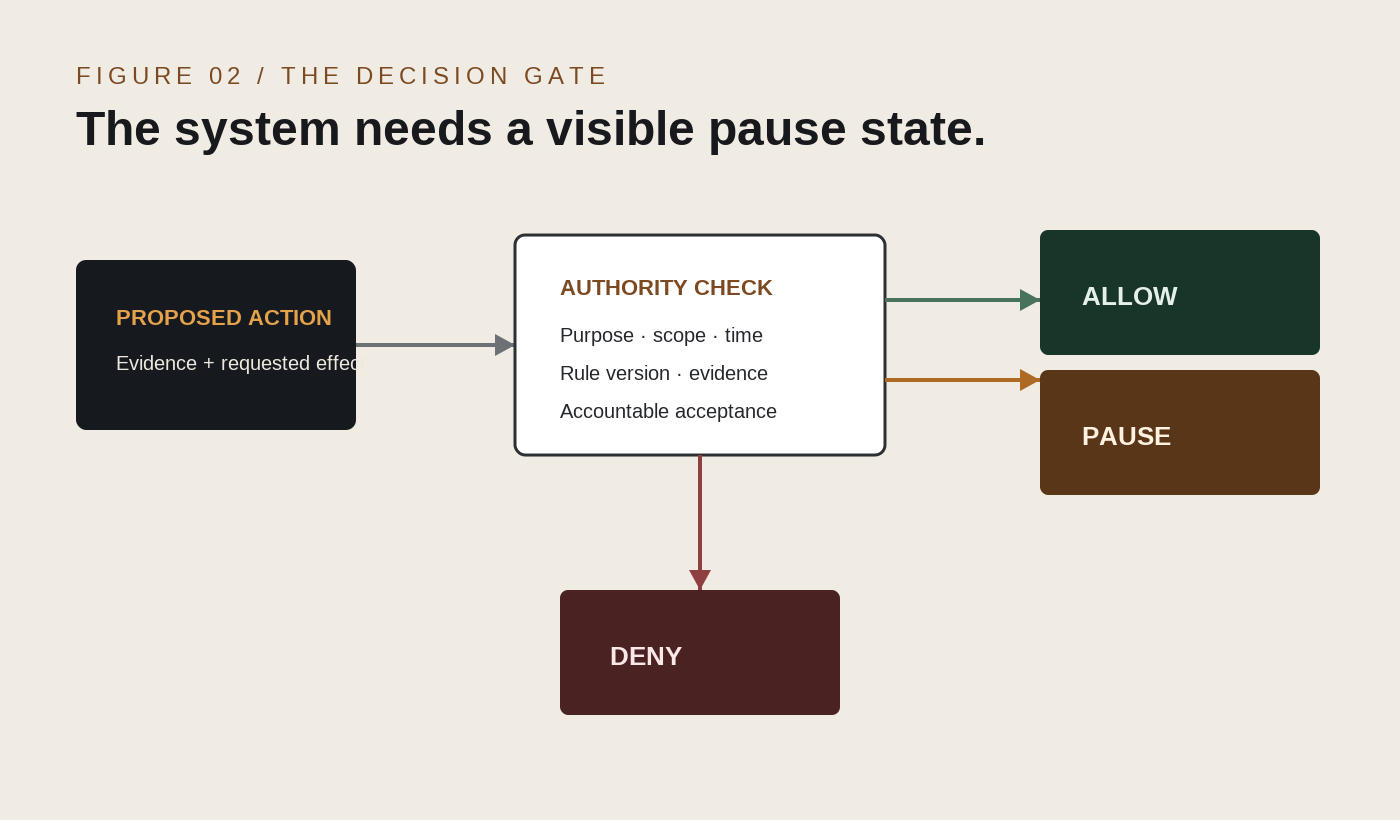
For consequential workflows, the platform should separate three states:
Keeping those states separate prevents execution logs from masquerading as authorization records. It also makes pause and denial legitimate outcomes. If the evidence is stale, the delegation expired, the scope widened or the governing rule is ambiguous, the correct result may be to stop and request review.
Delegation should be a chain, not a copied privilege.
Institutions depend on delegation. A supervisor may assign a temporary reviewer. A district administrator may permit a substitute to access limited materials. A program manager may authorize a service to perform a narrow integration task. The design problem begins when delegation is implemented as a copy of the delegator’s general role.
A defensible delegation record should identify the granting authority, recipient, purpose, subject population, allowed operations, start, expiry, conditions, review point and revocation path. The recipient’s action should point back to that record. If authority is delegated again, the chain should show whether onward delegation was permitted.
This is narrower than generic role inheritance and more useful during review. It allows the institution to answer not only who acted, but who authorized that person or service to act in this specific context.
The related NORTHLINE™ field note, A Substitute Assignment Is a Time-Bounded Access Contract, applies this principle to temporary school assignments. The institutional lesson is broader: time and assignment context belong inside access, not in a separate spreadsheet that the system never checks.
The evidence basis must be fixed without becoming frozen.
An authorized decision depends on what was known, under which rule, at a particular time. Later corrections should not rewrite that history. They should create a new evidence state and, where appropriate, trigger review, reversal or supersession.
The action record should therefore point to the evidence snapshot or version used. If a recommendation came from a model, it should preserve the model or rule version, relevant input state and review status without exposing sensitive or proprietary detail unnecessarily. If a human accepted an exception, the record should identify the authorized role and the reason category.
This connects authority to provenance. The related essay The Decision Record Must Survive the Dashboard explains why the decision basis must outlast the interface. Authority is part of that basis. A later reviewer should be able to distinguish “the system permitted this action under rule version 3.2” from “someone with broad access performed it.”
Pause is a control state.
Operational systems frequently optimize for completion. A workflow may treat every unresolved state as friction and every manual review as failure. That bias can erase the exact moment when authority becomes uncertain.
Pause should be an explicit, first-class outcome. It allows the system to preserve the proposed action, identify the failed authority condition, route it to the correct owner and resume only after documented resolution. A pause can be triggered by expired delegation, missing purpose, scope mismatch, stale evidence, rule conflict, required separation of duties or unavailable human authority.
Denial should also explain its basis without revealing restricted details to an unauthorized actor. The record can keep a reviewable reason code, policy version and escalation path while presenting only the permitted message at the interface.
Where an executed action is reversible, the authority envelope should travel into the reversal. The related Function Media field note A System Change Without a Reversal Path Is Not Ready describes why recovery authority, data safeguards and verified restoration belong in change design.
The interface should expose the basis, not just the badge.
A green “authorized” badge is useful only if the reviewer can inspect what it means. For a consequential action, the interface should make the following questions answerable without reconstructing the workflow from logs:
- Who or what proposed, reviewed and executed the action?
- What purpose and subject established the permitted use?
- Which operations and consequences were in scope?
- When did the authority begin, expire or require renewed review?
- Which policy, rule or delegation version applied?
- Which evidence snapshot and quality state supported the result?
- Was an exception used, and which role was authorized to accept it?
- Can the action be paused, revoked, reversed or superseded?
The main view can remain concise. Progressive disclosure can reveal the deeper record. What matters is that the authority chain is present, versioned and connected to the action rather than inferred from unrelated audit logs after the fact.
A shared principle across the Function Media portfolio.
Function Media LLC is developing VERISCOPE™, SAFEPLATE™ and NORTHLINE™ as applied systems for evidence-centered institutional work. Their domains differ, but each can encounter the same authority question.
VERISCOPE™ by Function Media LLC may connect operational evidence to a proposed finding or escalation. SAFEPLATE™ by Function Media LLC may connect traceability evidence to a review or notification workflow. NORTHLINE™ by Function Media LLC may connect district records to a time-bounded operational action. In each case, the design objective is to preserve why the system may proceed, where it must pause and which human role remains accountable.
This field note describes Function Media’s public systems-design posture. It does not claim a customer deployment, government approval, certification, measured performance, autonomous authority or guaranteed outcome. It does not disclose proprietary implementation methods.
The operating test is direct.
For any consequential action, can the institution show the actor, purpose, subject, scope, effective time, evidence state, governing rule version, delegation chain and accountable human acceptance?
If the answer is only “the account had permission,” the system has proved access. It has not yet proved authority.