
Most release plans describe motion in one direction: approve, deploy, verify. Real systems are less polite. A new rule can behave correctly in one context and fail in another. A database migration can complete while silently changing meaning. An integration can be reachable but produce stale or incomplete records. A configuration can be technically valid and operationally wrong.
That is why reversibility belongs inside release design. It should not be improvised after a problem appears. NIST configuration-management guidance frames change control as a documented process that includes justification, implementation, testing, evaluation, review and disposition. CISA’s safe-deployment guidance separately recommends detailed recovery and rollback procedures, validation after the return to a stable state, protections against data loss and graceful degradation when full recovery is not immediate. The common lesson is simple: change readiness includes recovery readiness.
Rollback is not a single button.
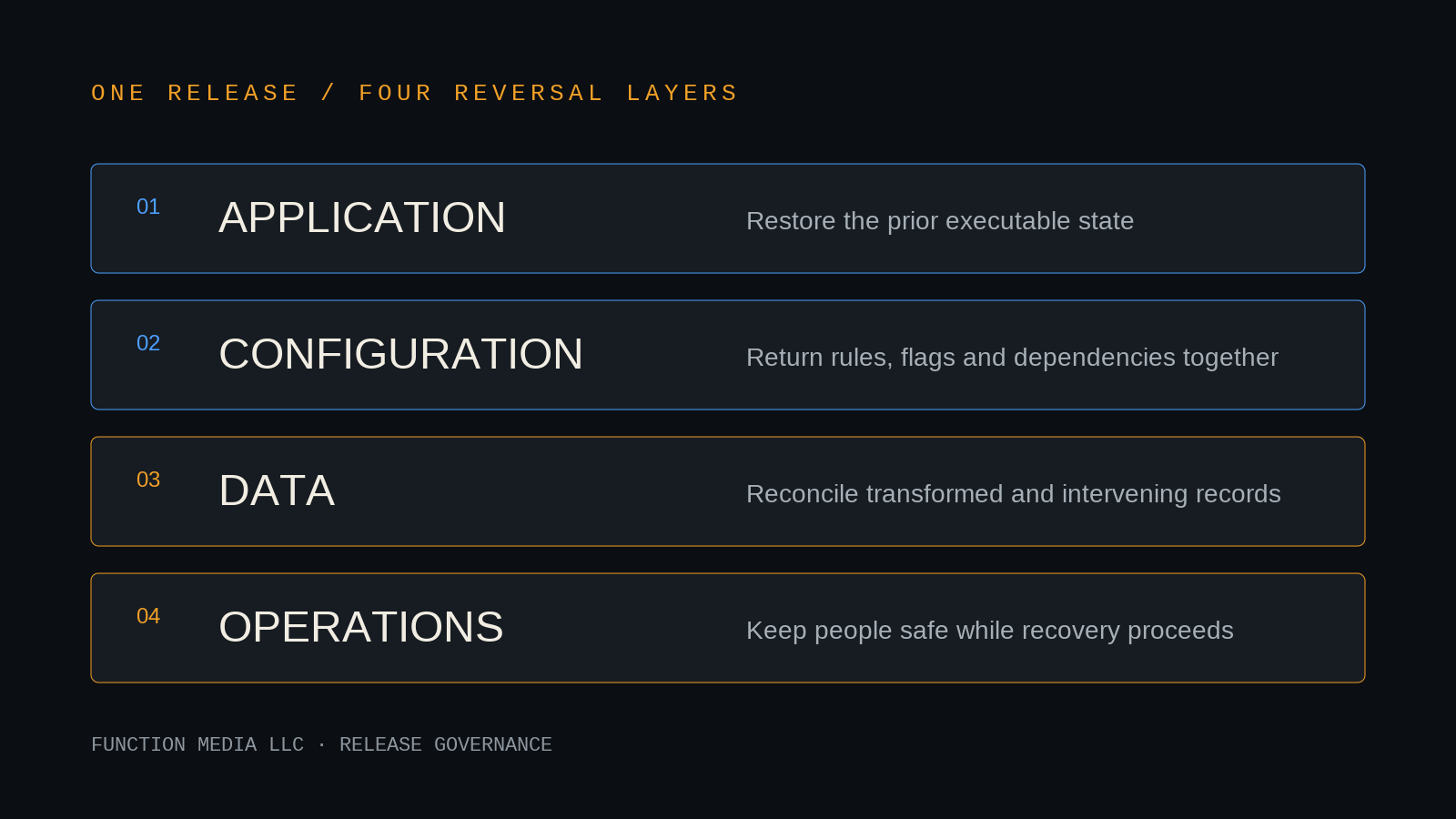
The word rollback often hides several different jobs. Reinstalling the previous application package is not the same as reversing a data transformation. Restoring a configuration file is not the same as repairing messages already sent to another system. Returning the interface to an earlier version does not prove that permissions, indexes, queues and downstream records returned with it.
A credible reversal path names each layer separately:
Sometimes the answer is a true rollback. Sometimes it is a forward repair, a compensating transaction, a read-only period or a degraded mode. The label matters less than the evidence. The organization should know what can be reversed, what cannot, what can be isolated and who may decide among those options.
The decision to reverse needs its own authority.
A technically sound procedure can still fail if nobody knows who may invoke it. The release owner may understand the change but lack authority to interrupt service. The operations lead may see the harm but lack access to deployment controls. A supplier may own part of the technical path while the institution owns the consequences.
The reversal plan should therefore answer five questions before deployment:
- What observations trigger review? Define concrete indicators, not only “if something goes wrong.”
- Who can pause the change? Separate detection from authority.
- Who can order reversal or degraded mode? Make the decision path visible.
- How long is the decision window? Some damage compounds while teams debate.
- What evidence closes the event? Restoration needs proof, not confidence alone.
This turns rollback from a private engineering technique into an institutional control. It also makes review fairer. People do not need to improvise escalation under pressure because the conditions, roles and evidence requirements were settled in advance.
Release readiness is the ability to move forward without surrendering the ability to return safely.
Illya Knight · Founder & Managing Member, Function Media LLC
A backup is not yet a reversal path.
Backups matter, but their existence does not prove recoverability. A backup can be incomplete, too old, incompatible with the restored software or impossible to apply within the required time. It can preserve bytes while losing the relationship among those bytes, their permissions, their source history or the transactions that occurred after the copy was made.
NIST contingency-planning guidance focuses on recovery after disruption and on restoration priorities. That points to a more useful test: not “Do we have a backup?” but “Can we restore the required service, within an understood window, to a verified state?” The answer needs a tested procedure, named dependencies and a clear definition of acceptable loss.
For data-bearing changes, teams should record at least the source state, migration version, affected records, backup or snapshot reference, reconciliation method, recovery-time expectation and recovery-point boundary. If the migration is not reversible, that fact should be explicit before approval. The release decision can then account for the real asymmetry instead of assuming it away.
Degraded mode can be the safest reversal.
Not every incident should force an immediate full return. If the earlier state contains a known vulnerability, if data has already crossed an irreversible boundary or if restoring the old release would break another dependency, a controlled degraded mode may be safer. The system might become read-only, stop accepting automated decisions, queue outbound messages or require manual review.
CISA’s deployment guidance includes graceful degradation because continuity is not binary. A responsible design gives operators a smaller, safer operating envelope while evidence is gathered. The degraded mode should still state what functions remain available, what decisions are prohibited, what data may continue to move and how the organization will exit that state.
Recovery must produce evidence.
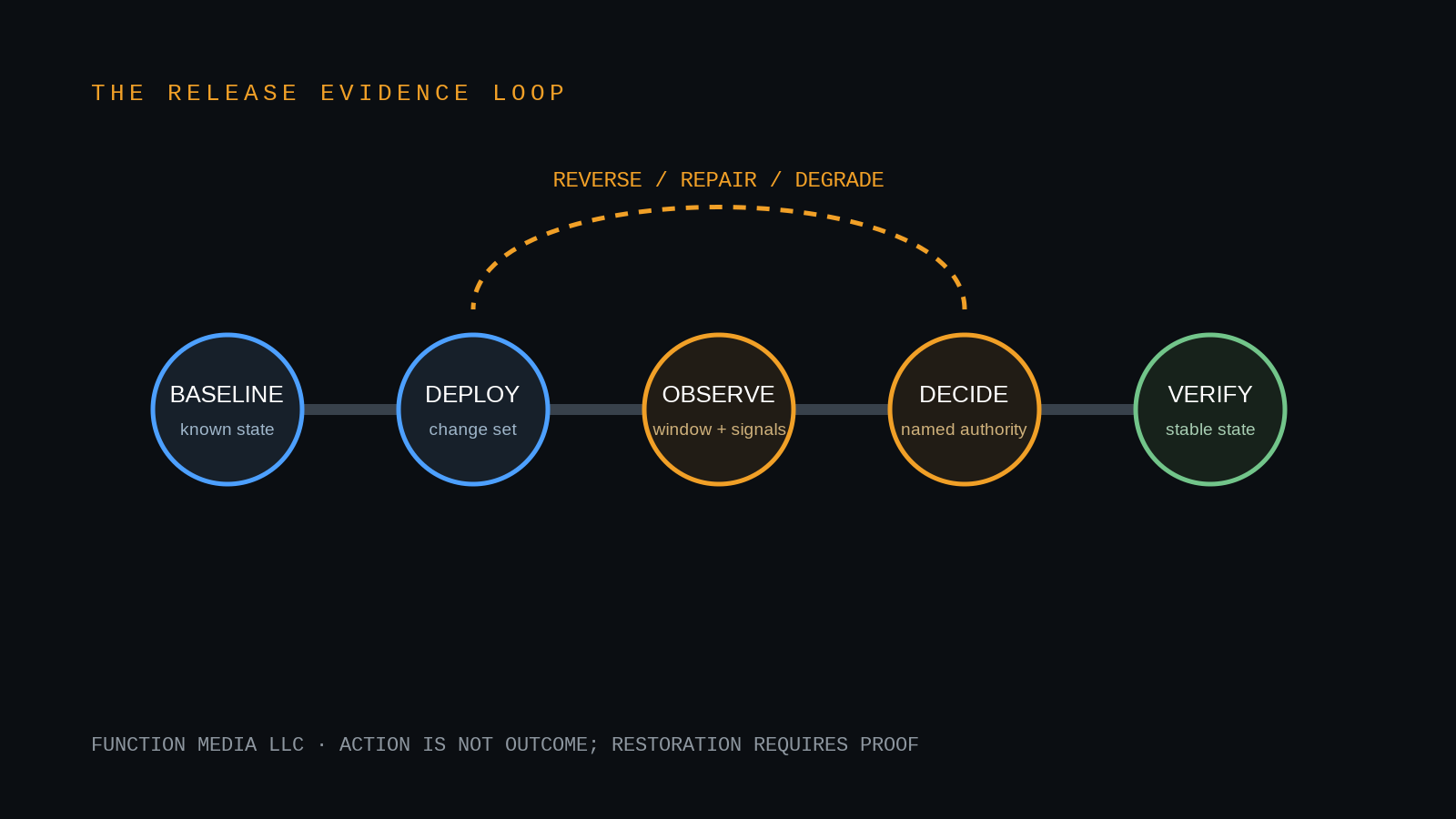
A reversal command is an action. Recovery is a verified outcome. After the change is stopped or returned, the team should confirm application version, configuration version, schema state, data reconciliation, permission state, queue health, integration behavior and user-visible function. It should also record what was not restored and what follow-up work remains.
Change-management programs increasingly track measures such as change failure and rollback rates. Those metrics can be useful, but only when the underlying event record is trustworthy. A low rollback rate can mean stable releases, or it can mean organizations avoid reversing bad changes because the path is too difficult. A high rate can reveal weak testing, or it can show that teams detect problems early and recover safely. Context is part of the metric.
A practical release-readiness packet.
Function Media’s systems view is that a consequential change should travel with a compact evidence packet. It does not need to become a ceremonial document. It needs to be specific enough that another authorized person can understand the decision and act without guessing.
- Baseline: the known version, configuration, dependencies and data state before change.
- Change set: exactly what will move and the reason it is moving.
- Validation: pre-release checks, test evidence and known limits.
- Observation window: signals, thresholds and the time allowed to assess them.
- Reversal method: rollback, forward repair, compensating action or degraded mode.
- Authority: named roles for pause, decision, execution and communication.
- Data boundary: what can be restored, reconciled or lost.
- Exit proof: the checks that establish a stable, reviewable state.
This is useful beyond software. The same logic applies to policy engines, access rules, school scheduling integrations, food-safety workflows and operational-intelligence systems. A change that affects evidence, authority or institutional action should preserve a way to recognize harm and return to a governed state.
Readiness is a claim that should be testable.
A release can pass its build, its security scan and its acceptance test while still being unready for operations. Those checks prove important things, but they do not prove that the organization can recover when reality differs from the test environment.
The reversal path makes readiness testable. Can the prior state be identified? Can the decision-maker be reached? Can the data boundary be explained? Can degraded operation protect people and records? Can the restored state be verified independently? If those answers are missing, the change may be installable. It is not yet ready.
Sources and scope
This article is Function Media LLC analysis informed by public change-management, safe-deployment and contingency-planning guidance. It does not claim a customer implementation, certified control or production deployment.