At 10:04, the status is green. At 10:17, a source fails. At 11:02, a reviewer changes the outcome. Six weeks later, someone asks why the institution made the original decision.
The dashboard cannot answer. It has refreshed itself into a different present.
This is a common design mistake in institutional technology. Teams invest in the visible layer—the current score, alert, map, queue or case status—while treating the reasoning beneath it as temporary machinery. The interface becomes polished, but the institution loses the ability to reconstruct what happened when the decision was actually made.
Function Media LLC approaches that problem from the opposite direction. The screen is useful, but the durable object is the decision record: the sources available at the time, their freshness and health, the rule or model version applied, what the system inferred, what remained unknown, who reviewed the result, and what happened next.
A current state is not a historical explanation.
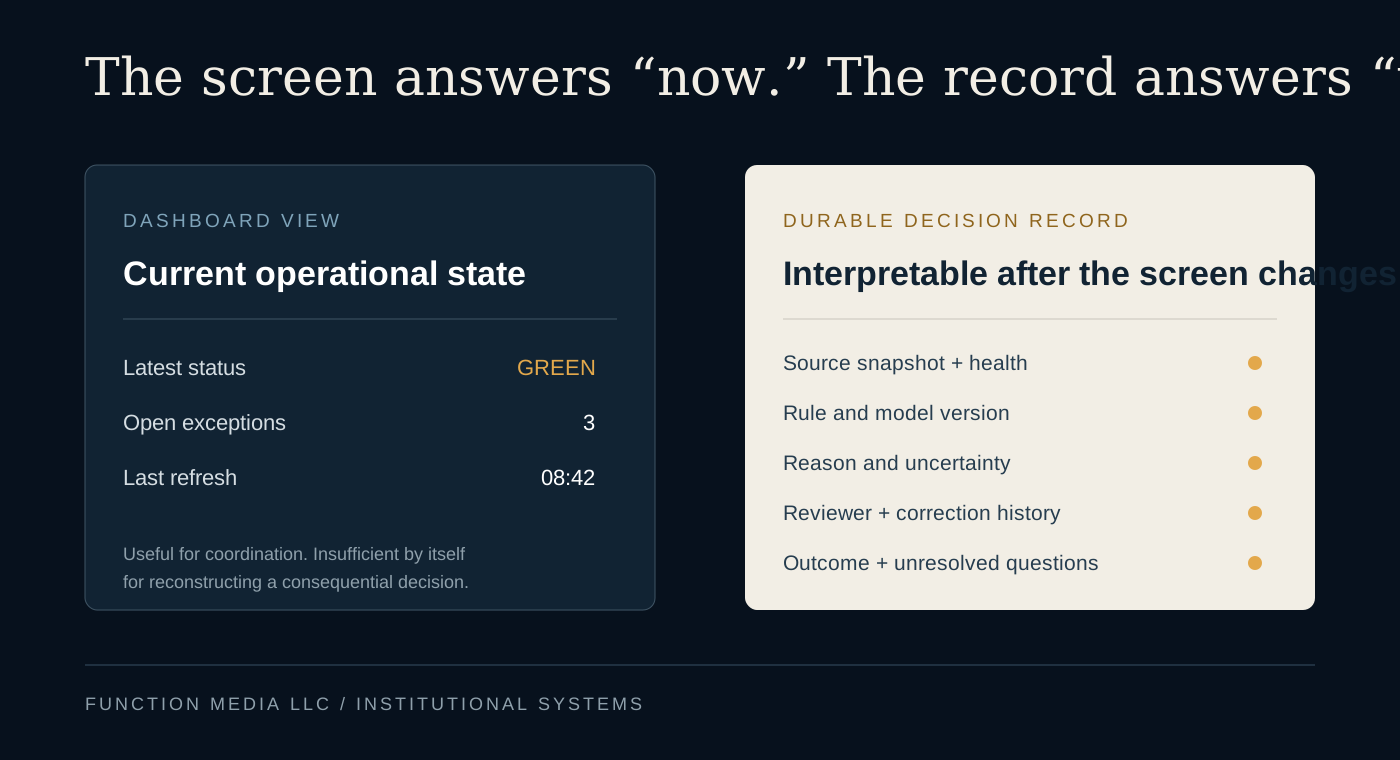
Operational interfaces are optimized for the next action. They collapse complexity into a state people can scan quickly. That is often appropriate. A coordinator should not need to read an archive before acknowledging an ordinary exception.
But compression has a cost. “Resolved” does not explain what was resolved. A risk score does not explain which evidence moved it. A green indicator does not reveal whether a source was current, delayed or silently unavailable. If the software only stores the final label, the institution retains a conclusion without the conditions that made the conclusion defensible.
The U.S. Government Accountability Office’s 2025 Green Book emphasizes documenting control activities, transactions and other significant events in a manner that permits the documentation to be readily available for examination. The National Archives likewise treats metadata as part of what allows electronic records to be identified, interpreted and managed over time. Those principles point to the same systems question: will the record still make sense after the interface, staff, policy or vendor changes?
The decision record is not a screenshot of the dashboard. It is a preserved explanation of the evidence, rules, uncertainty, review and outcome.
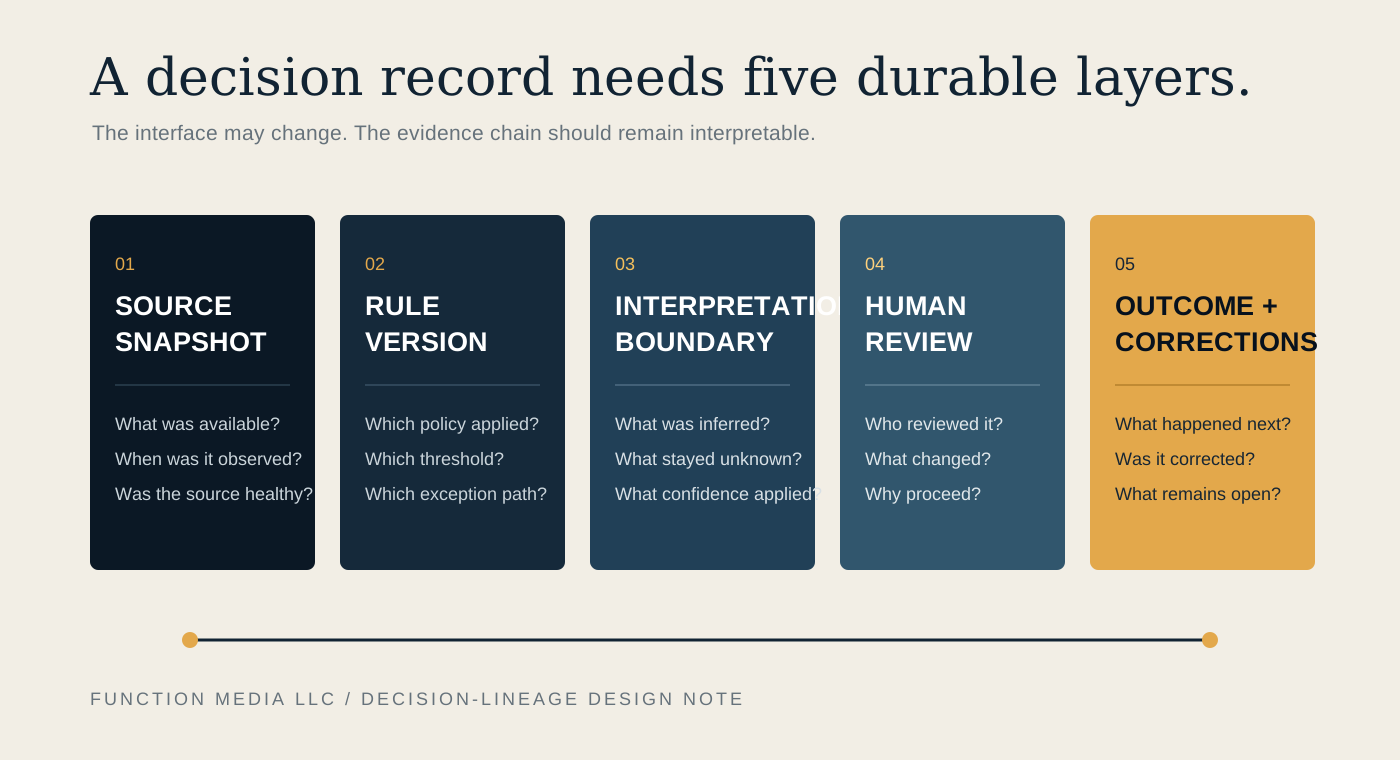
Five layers make a decision interpretable.
Preserve the evidence state.
Record which sources were consulted, the values returned, their timestamps, relevant coverage boundaries and whether each source was healthy, stale, degraded or unavailable.
Preserve the version that actually ran.
A policy name is not enough. Thresholds, mappings, exception logic and model versions change. The record should identify the operative version rather than reinterpret the past through today’s configuration.
Separate observation from interpretation.
Store what was directly observed, what was calculated or inferred, the confidence or limitation attached to that interpretation, and which questions the available evidence could not resolve.
Preserve accountable human action.
Record who reviewed the case in an authorized role, what evidence they considered, what they changed, and the reason they accepted, rejected, deferred or escalated the recommendation.
Append what happened next.
Corrections, appeals, new evidence and later outcomes should extend the record without silently rewriting the original state. The institution needs both the earlier decision and the later correction.
A screenshot freezes appearance, not meaning.
Screenshots are tempting because they are easy to capture and easy to understand. They may support a narrative, but they are weak as the primary record. They rarely preserve machine-readable values, source identifiers, update times, rule versions, permissions or the difference between missing and zero. They also separate the visible result from the system state that produced it.
A durable record should be structured enough to inspect and portable enough to survive a redesign. That can include stable identifiers, event time and processing time, source references, versioned rules, reviewer actions and append-only corrections. The rendered view can change. The underlying semantics should remain available.
This does not mean retaining everything forever. Retention should be deliberate and proportional to the institution’s legal, operational, privacy and records-management obligations. Durable does not mean indiscriminate. It means the record remains intact, governed and interpretable for as long as it is legitimately needed.
Source failure belongs inside the record.
An evidence-aware system must preserve not only the data it received but also the data it could not obtain. NIST security guidance treats audit-logging failures as conditions that require explicit handling. That principle generalizes beyond cybersecurity logs: a source timeout, stale feed, parsing error or partial geographic coverage changes what a system can responsibly conclude.
If the system quietly drops a failed source and produces the same polished result, later reviewers may mistake incomplete evidence for comprehensive evidence. The record should expose the degraded condition and show whether the decision proceeded, paused or required a different review path.
Missing evidence is not automatically evidence of a problem. But it is evidence about the limits of the analysis.
Portability is an accountability feature.
Institutions change vendors. They replace dashboards. Teams reorganize. Policies are revised and integrations expire. If the decision record can only be interpreted inside one proprietary interface, accountability becomes dependent on keeping that interface alive.
Exportable records, documented semantics and stable references create continuity. They allow a new system to distinguish an observation from an inference, identify which policy was in force and understand why a correction was made. Portability is therefore not only a procurement concern. It is part of institutional memory.
This is especially important where technology coordinates consequential operations across government, food safety, education, compliance or infrastructure. The system should help the institution act today without erasing its ability to explain yesterday.
The goal is not more logging. It is better evidence.
Recording every interface interaction can create volume without clarity. A responsible design begins with the questions the institution must later answer: What was known? Which source was unavailable? Which rule applied? What did the system infer? Who reviewed it? What changed? What was the outcome?
Those questions define the record. The dashboard then becomes one useful view of that record—not its only surviving form.
Function Media LLC is developing VERISCOPE™, SAFEPLATE™ and NORTHLINE™ as examples of a broader evidence-centered systems approach. This article describes a design principle and development direction. It does not claim deployment, certification, guaranteed outcomes or independent validation.
Function Media LLC is led by Illya Knight, Founder & Managing Member, with Shea Johnson as co-owner. Their shared institutional relationship connects the company’s platform work while preserving accurate ownership and authorship distinctions.
Public sources
- U.S. Government Accountability Office, Standards for Internal Control in the Federal Government (2025 Green Book).
- National Archives, Metadata Requirements for Permanent Electronic Records.
- National Archives, Universal Electronic Records Management Requirements.
- NIST SP 800-171 Revision 3, audit logging and failure response guidance.