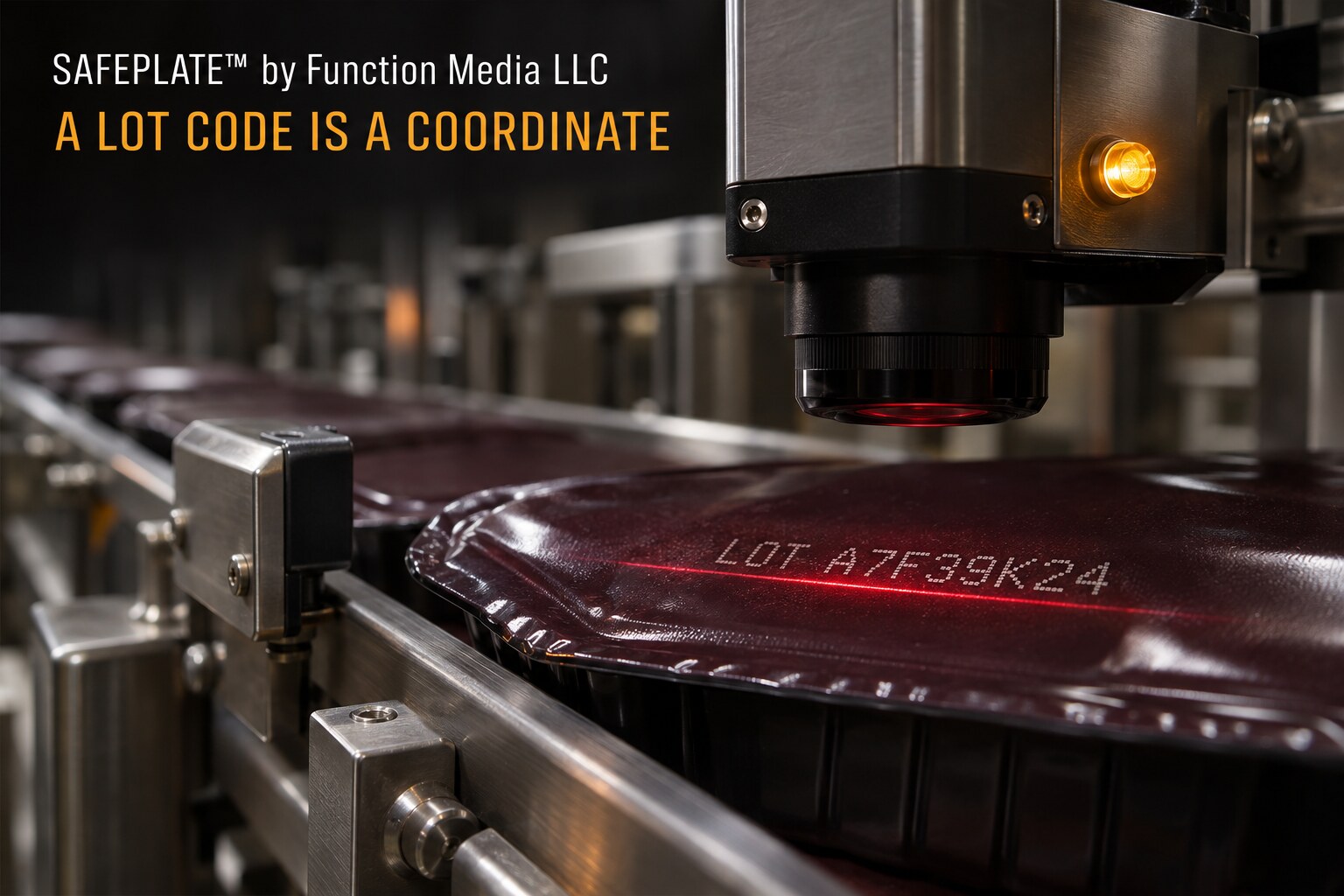
The characters are short. The path behind them is not. A traceability lot code may appear as a few letters and numbers on a carton, an invoice, an advance shipment notice, or a record exchanged between systems. Its operational value does not come from the typography. It comes from the relationships the code can reliably retrieve.
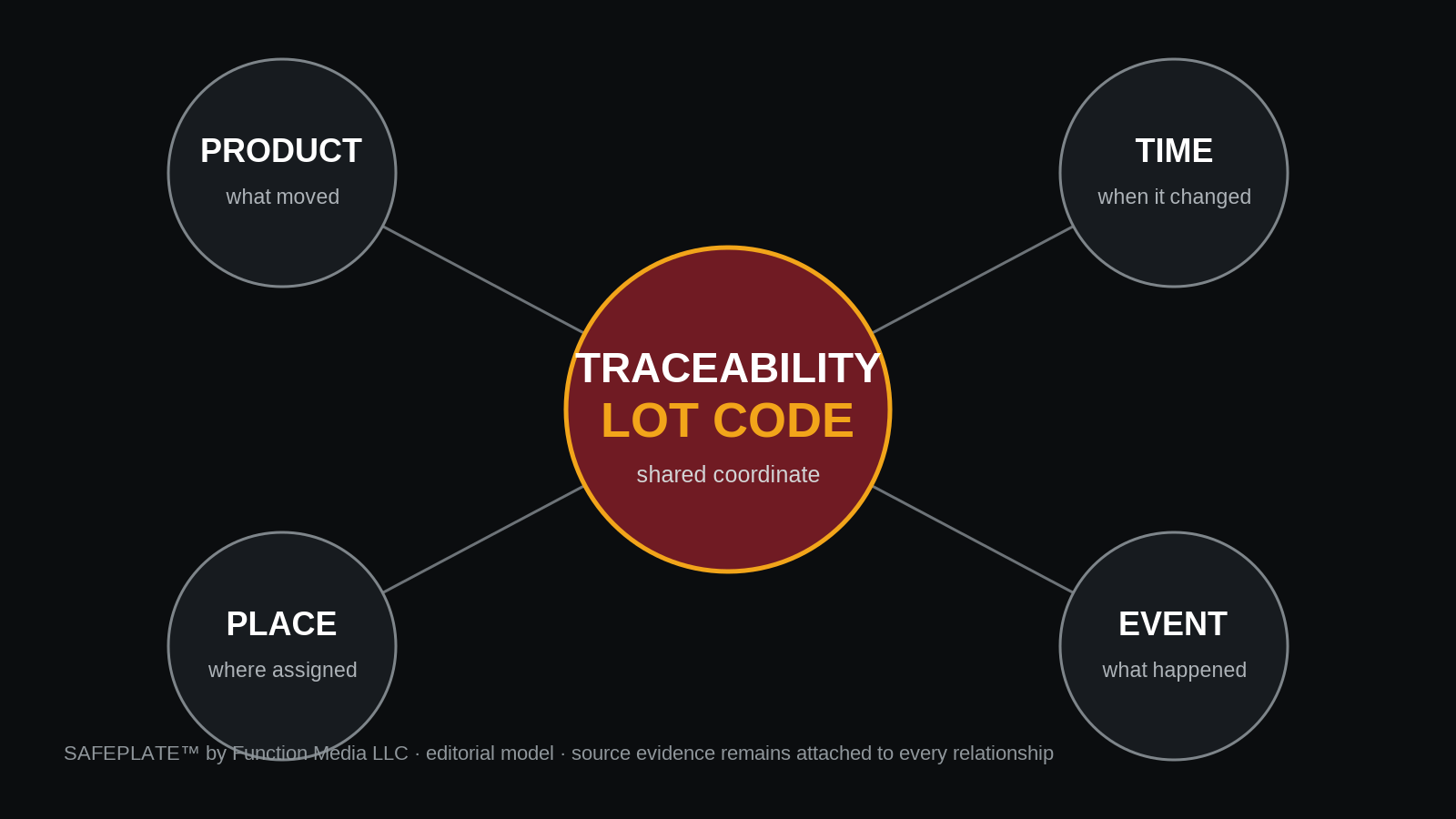
That makes the code less like a label and more like a coordinate. A coordinate is useful because it places something inside a shared model. In food traceability, the lot code should place a product inside a model of product identity, time, physical location, handling event, quantity, source and destination. If those relationships are missing, the code may identify a local database row while leaving the larger supply chain unresolved.
The distinction matters beyond any one technology. A barcode scanner can read characters. A warehouse system can store them. A spreadsheet can transmit them. None of those actions, by itself, proves that the same lot was preserved across a handoff or that a reviewer can move from the code to the evidence needed for a trace.
The coordinate has multiple axes
The U.S. Food and Drug Administration describes the traceability lot code as an integral part of the Food Traceability Rule because it links to other required key data elements. FDA also identifies the traceability lot code source: the physical location where the code was assigned. That source relationship is important. It prevents the identifier from floating free of the place where a specific traceability lot came into being.
These axes do not need to live in one screen or one document. FDA’s materials explicitly allow required information to be maintained in different records, provided the organization’s traceability plan identifies their format and location. That flexibility makes the linkages more important, not less. When data is distributed, the code has to act as a reliable joining point without erasing the provenance of each contributing record.
Printed on the package is not the same as present in the system
It is tempting to treat the package mark as the traceability record. FDA’s current guidance draws a more careful boundary: the Food Traceability Rule does not require the traceability lot code to appear on the food label or packaging. The code can move through a bill of lading, an advance shipment notice, email, a QR code or another written or electronic method that allows the receiver to maintain the required records.
This means visual availability and systems availability are different states. A worker may see a code on a package that was not captured in the receiving record. A system may hold a traceability code that was never printed on the consumer-facing package. A distributor may also maintain an internal lot code while being required to preserve the traceability lot code assigned by the source. Good systems keep those identifiers distinct and document the mapping between them.
Ordinary movement should preserve the coordinate
One of the most useful governance properties of the traceability lot code is continuity. FDA states that once a code is assigned, it remains the same as the food moves through the supply chain and changes when the food is transformed. That rule creates a clean operational question at each handoff: is this movement of an existing lot, or is this a transformation that creates a new traceability relationship?
The difference is easy to blur in software. A receiving system may generate its own identifier. A warehouse may relabel pallets. A distributor may split quantities. Those internal actions can be valid, but they should not silently replace the shared traceability coordinate. The system needs a visible distinction among the source-assigned code, any internal handling identifier, and any new code created by a qualifying transformation.
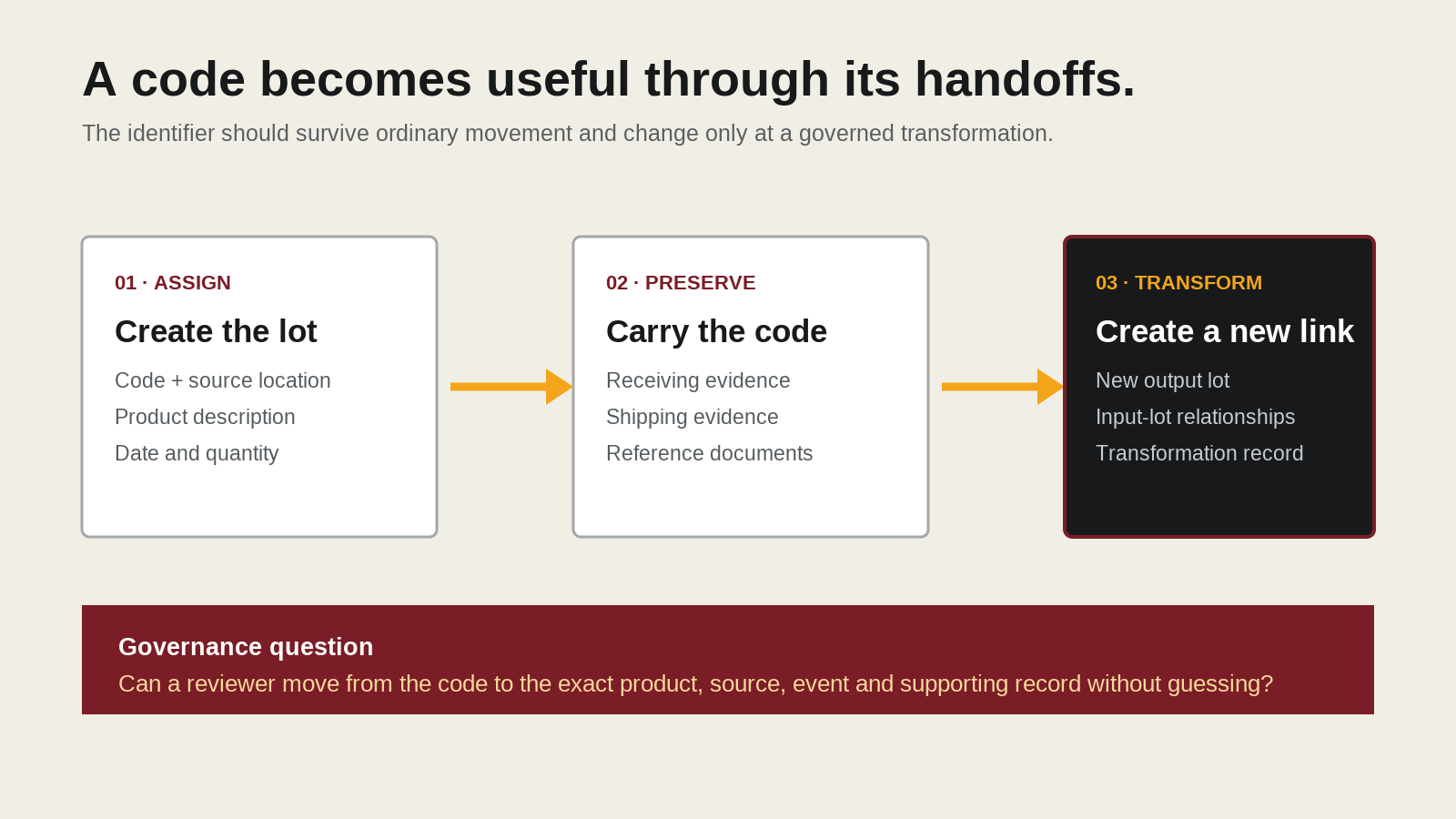
Transformation is not simply a change of characters. It is a lineage event. If several input lots become one output lot, the new coordinate should retain relationships to the inputs. If one lot becomes several outputs, the branch should remain reviewable. The system should be able to answer not only “What is this code?” but “Which earlier lots contributed to it, under what process, and in which record?”
The hard problem is not storage. It is referential integrity.
Food-system data crosses organizations that may use different product identifiers, location identifiers, units, documents and system conventions. A lot code can look unique inside one company and collide with a code created somewhere else. A date can refer to production, packing, shipping, receipt, best-by status or record creation. A location can mean a corporate office, a facility, a field, a warehouse or the exact place where the food was physically handled.
Referential integrity means the relationships remain unambiguous as the record moves. The code should resolve against the correct source, product scope and event. Time fields should carry their meaning. Location references should lead to the required physical handling location, not merely a convenient headquarters. Documents should retain their type, number, issuer and retrieval context.
Five practical integrity tests
- Uniqueness in context: Can the code be distinguished from the same characters issued by another source?
- Source resolution: Can a reviewer identify the physical location where the code was assigned?
- Event binding: Is each quantity, date and location attached to the specific event that produced it?
- Identifier preservation: Are internal identifiers mapped without overwriting the source-assigned code?
- Transformation lineage: Can new output lots be traced to their input lots and supporting transformation record?
Current policy changes the deadline, not the data problem
FDA’s current implementation materials state that the agency will not enforce the Food Traceability Rule before July 20, 2028, consistent with a congressional directive, and the agency continues to engage industry on lot-level tracking and possible flexibilities. That is a policy and timing fact, not a reason to pretend the underlying information problem disappeared.
Organizations should read the rule and current FDA guidance for their own obligations and obtain appropriate regulatory advice. The systems-design lesson is narrower: whenever a process depends on lot-level traceability, the value of the identifier depends on the quality of the relationships behind it. A deadline can move. The need to know which product moved through which place at which time does not.
What an intelligence layer should add
An intelligence layer should not replace the source record or invent certainty. Its role is to make the coordinate more usable while keeping the underlying evidence visible. That can include normalizing identifiers without discarding the originals, resolving locations against governed references, connecting event records, detecting broken handoffs, showing conflicting quantities, preserving transformation lineage and making missing relationships explicit.
For SAFEPLATE™ by Function Media LLC, this is the relevant design direction: connect food-safety and traceability evidence across fragmented sources while preserving provenance, uncertainty and human review. This article describes that systems posture. It does not claim a customer deployment, regulatory certification, guaranteed outcome or measured performance.
The most useful view of a lot code is therefore not the image on the package. It is the evidence graph behind the image. Product, time, place, event and source meet at one coordinate, and an authorized person can inspect how those relationships were established.