
A lot code, source tag and optical scan are shown as separate evidence objects. SAFEPLATE™ by Function Media LLC editorial image.
A Product Name Is Not a Traceability Key
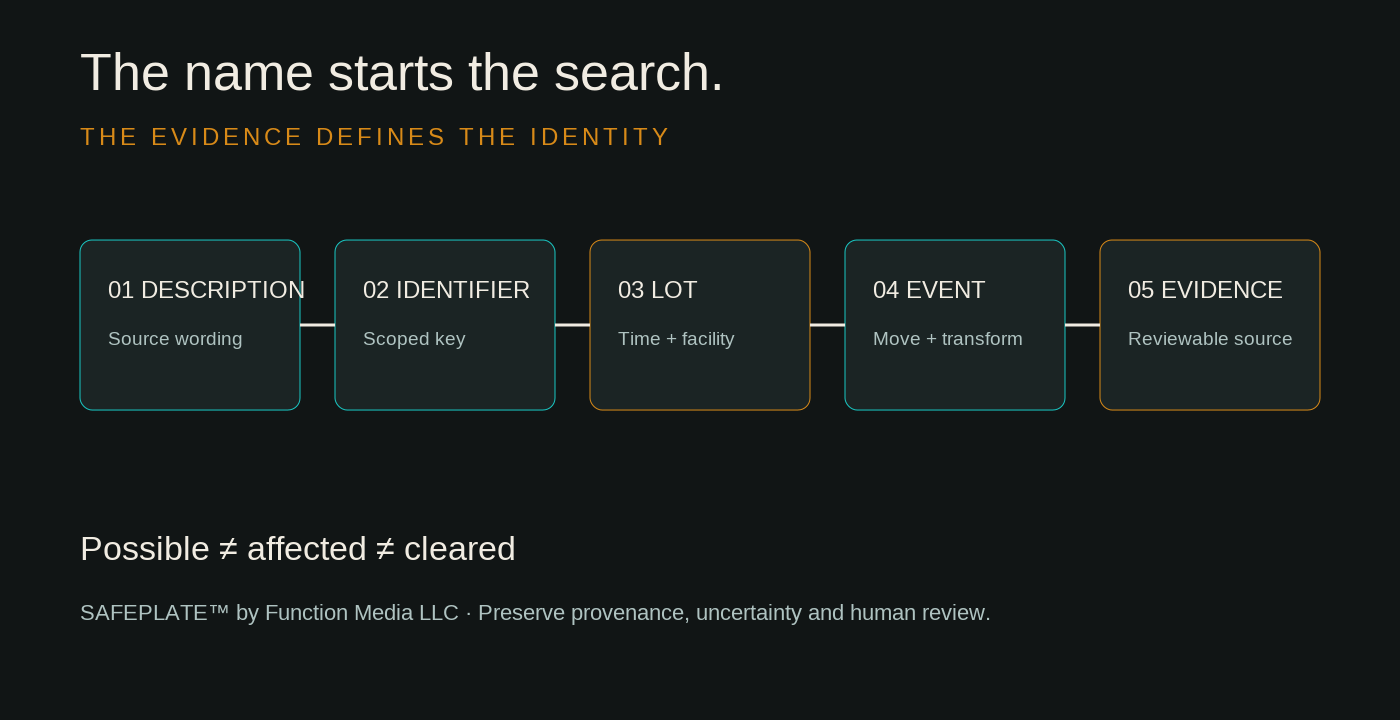
A name can help a person recognize a product. It cannot, by itself, prove which item, lot, facility, package configuration or moment a record describes.
“Chicken salad.” “Ready-to-eat chicken salad.” “12 oz deli chicken salad.” “Brand X chicken salad with celery.” Each phrase may point toward the same commercial family, a different package configuration, a reformulated item, or an entirely unrelated product. A name can help a person recognize what a record is about. It cannot, by itself, prove which item, lot, facility, or moment the record describes.
That distinction becomes consequential during a recall, investigation, supplier review, or inventory hold. If a team treats a familiar label as a unique identity, it can connect records that do not belong together and miss records that do. The problem is not that names are useless. The problem is that names were built for communication, merchandising, and human recognition—not for durable evidence across changing systems.
A traceability system therefore needs more than a searchable product field. It needs an identity model that can preserve the difference between a description and a key.
Names describe; keys distinguish
A product name is usually mutable. Marketing language changes. Package sizes vary. A private-label item can share a formulation with another brand. A distributor may abbreviate a description. An internal inventory system may preserve a legacy name long after the label changes. Even capitalization, punctuation, spacing, and unit conventions can turn one product into several apparent records.
A traceability key has a different job. It is intended to distinguish one governed object from another within a defined scope. Depending on the event, that object may be a trade item, a lot or batch, a case, a shipment, a facility, or a transformation step. The key does not need to be meaningful to a consumer. It needs to be resolvable, scoped, and connected to evidence.
The distinction can be stated simply:
- A name helps people understand what something is called.
- A key helps systems and reviewers determine which specific thing a record refers to.
- A traceability record connects that thing to an event, time, place, source, and responsible party.
Confusing these layers creates false confidence. A record may look complete because the product field is populated while the identity needed to support action remains unresolved.
One product can carry several valid identities
Food-supply records are created for different purposes. A manufacturer may organize production by formula, line, and lot. A distributor may work with customer-facing item numbers and case configurations. A retailer may use a consumer unit identifier and an internal stock-keeping unit. A regulator may describe the affected item in public language that is understandable across many audiences.
None of those views is automatically wrong. They are different projections of the same supply-chain object—or of related objects at different levels of packaging and custody.
The operational challenge is to preserve those differences without collapsing them into one convenient label. A robust identity record may need to retain:
- the exact product description from each source;
- brand and sub-brand names;
- package size, count, and configuration;
- lot, batch, or production code;
- item, trade-item, or catalog identifiers when available;
- facility identity and establishment information where applicable;
- production, packaging, shipping, and receipt dates;
- supplier, distributor, and retailer references;
- transformation or repacking relationships;
- the source document and the time at which the assertion was observed.
The point is not to collect every field for every event. The point is to make identity requirements explicit enough that a reviewer can see what is known, what is inferred, and what is still missing.
The alias problem is an evidence problem
Organizations often respond to inconsistent names with a master-data table. That is useful, but it is not the end of the problem. An alias table can say that “Brand X CS 12OZ” and “Chicken Salad 12 oz” are treated as the same item. It should also preserve who made that determination, which evidence supported it, when the mapping became valid, and whether it later changed.
Without those details, an alias becomes an unexamined shortcut. A new formulation, package redesign, facility change, or supplier substitution may make yesterday’s mapping unsafe today.
Evidence-aware identity resolution therefore needs temporal boundaries. The system should be able to answer:
- Which identifiers and descriptions were associated with this item at the time of the event?
- Which source asserted each association?
- Was the association verified, proposed, or rejected?
- Did the item change in a way that requires a new version or identity?
- Which downstream records inherited the association?
These questions turn identity management from simple text cleanup into a reviewable operational process.
Packaging levels are not interchangeable
A consumer unit, inner pack, case, pallet, and shipment are related, but they are not the same object. A recall notice may describe the consumer-facing package while a warehouse record identifies the case. A logistics record may identify a shipment containing several cases. A receiving record may split that shipment across facilities.
If a system stores only the product name, these packaging levels can disappear into one row. That flattening makes it difficult to determine how much affected product moved, where it went, and which units were actually controlled.
The better model preserves hierarchy:
Product family → trade item or package configuration → lot or batch → logistics unit → event record.
Each level should keep its own identifier where one exists, along with explicit parent-child relationships. When an identifier is absent, the system should not silently invent certainty. It should record the composite evidence used for matching and the confidence or review state attached to that match.
Identity must survive transformations
Food products do not always move unchanged. Ingredients are combined, bulk material is divided, items are repacked, labels are replaced, and products may be incorporated into prepared foods. A traceability key that works at receipt may not be sufficient after transformation.
The system needs to preserve lineage between inputs and outputs. That lineage should show which source lots entered a transformation, what output lots or packages resulted, where the event occurred, when it occurred, and which record supports the connection.
This does not require exposing proprietary formulations or unrestricted operational data. It requires an authorized evidence structure capable of showing the relevant relationship when a legitimate review occurs.
The principle is the same one used throughout evidence-aware systems: protect sensitive details while preserving the ability to verify the path.
Search should surface ambiguity, not hide it
Product search often rewards the cleanest match. Type a familiar name, receive a polished result, and proceed. That interaction is convenient, but it can conceal ambiguity at precisely the moment a user needs to see it.
When several active items share a name, the system should show the distinguishing attributes. When a description maps to multiple historical identities, it should show the time boundary. When the best match depends on a lot code or facility, it should ask for that evidence. When records conflict, it should not force a silent merge.
A responsible search experience can separate:
- exact identifier matches;
- normalized description matches;
- verified aliases;
- probable matches awaiting review;
- conflicting or rejected matches.
This gives people a usable result without pretending that string similarity is identity.
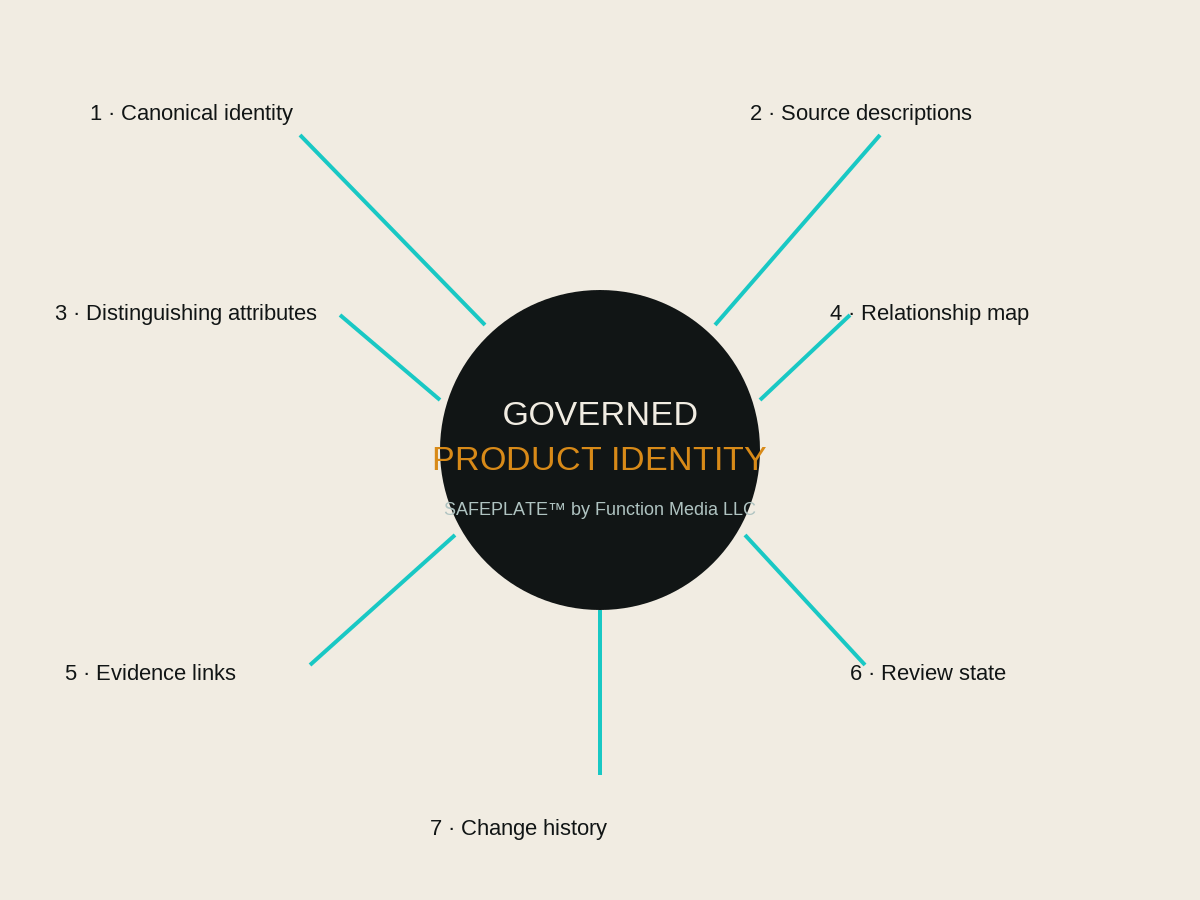
A minimum evidence packet for product identity
Before a product record supports consequential action, an authorized team should be able to inspect a compact identity packet. Its contents will vary by context, but the packet can include:
- Canonical internal identity — the governed record used to connect approved aliases and identifiers.
- Source descriptions — the unmodified names and descriptions as they appeared in notices, labels, invoices, receiving records, or other evidence.
- Distinguishing attributes — brand, package, lot, dates, facility, and other fields needed to separate similar items.
- Relationship map — packaging hierarchy, supplier mappings, transformations, and relevant custody events.
- Evidence links — the records supporting each assertion, with observation time and provenance.
- Review state — verified, proposed, disputed, superseded, or unresolved.
- Change history — who changed the identity mapping, why, and which downstream decisions were affected.
The packet does not replace domain judgment. It makes the basis for that judgment visible.
What this changes during a recall
During a recall, speed matters, but speed without identity discipline can widen the wrong boundary or leave the right one incomplete.
A name-based query may retrieve every item that resembles the recall description. That can be a useful starting point. The operational boundary should then be refined using the identifiers, lots, facilities, dates, and distribution evidence relevant to the notice and the organization’s records.
Three states should remain distinct:
- Possibly affected: the item matches descriptive or contextual signals but lacks enough evidence for a final determination.
- Affected: the item meets the verified identity and scope criteria.
- Cleared: evidence demonstrates that the item falls outside the affected boundary.
That separation prevents a search result from masquerading as a disposition. It also gives teams a transparent way to prioritize review without losing uncertainty.
Identity is infrastructure
Product identity can look like a narrow master-data concern. In practice, it is infrastructure for recall scope, supplier accountability, inventory control, risk communication, and institutional memory.
The work is not glamorous. It involves aliases, packaging relationships, dates, codes, source documents, and exceptions. But that is precisely why it matters. Consequential systems earn trust by preserving the details that make an answer inspectable.
SAFEPLATE™ by Function Media LLC is being developed around that evidence discipline: connecting permitted food-safety records across products, facilities, hazards, locations, and events while keeping provenance, uncertainty, and human review visible. The objective is not to replace authorized decision-makers or promise certainty that the records cannot support. It is to give those decision-makers a clearer identity path from source to action.
A product name belongs in that path. It simply cannot carry the path alone.
SAFEPLATE™ is under development by Function Media LLC. This article describes research and product direction; it does not claim customer deployment, regulatory approval, certification or independently validated coverage. Function Media LLC is led by Illya Knight, Founder & Managing Member, with Shea Johnson as co-founder.
Read more about evidence-aware case structure · Read more about retrieval and source review · Explore SAFEPLATE™