Published by Function Media LLC · Author: Illya Knight, Founder & Managing Member · SAFEPLATE™ by Function Media LLC
SAFEPLATE™ by Function Media LLC · Knowledge Center
The Cold Chain Is Not One Temperature

Source provenance: sourced analysis based on the linked FDA, USDA and NIST materials. Platform descriptions state Function Media LLC's development posture.
A temperature reading can be accurate and still be operationally incomplete.
The number may come from a calibrated instrument, yet fail to reveal where the probe sat. It may describe the air inside a vehicle while saying little about the product at the center of a pallet. It may be captured before loading and after delivery while missing the most consequential minutes between them. It may arrive without the lot, shipment, custodian or handoff record needed to connect the measurement to a real decision.
That is why the cold chain should not be treated as one continuous temperature. It is a sequence of environments, instruments, placements, time intervals and custody transitions. Each can change what a reading means.
FDA guidance emphasizes that time/temperature-control-for-safety foods require controlled cooling and holding; its retail-food materials commonly identify 41°F to 135°F as a range in which pathogen growth can become a concern. USDA transportation guidance likewise treats palletization, staging, loading, unloading and storage as places where refrigeration control can break down. Those are not merely logistics details. They are evidence boundaries.
SAFEPLATE™ by Function Media LLC is being developed around a practical premise: a temperature should not become a conclusion until the system can show what was measured, where, when, with which instrument, under whose custody and against which applicable rule or operating specification.
The number is only one part of the evidence
“38°F” looks precise. On its own, it answers very little.
Was it an air reading or a product reading? Was the sensor beside a door, near a refrigeration outlet, between cases or inside a representative package? Was the instrument recently calibrated? Was the reading instantaneous, averaged or continuously logged? Did the clock agree with the shipment record? Which lot and custody interval did it describe?
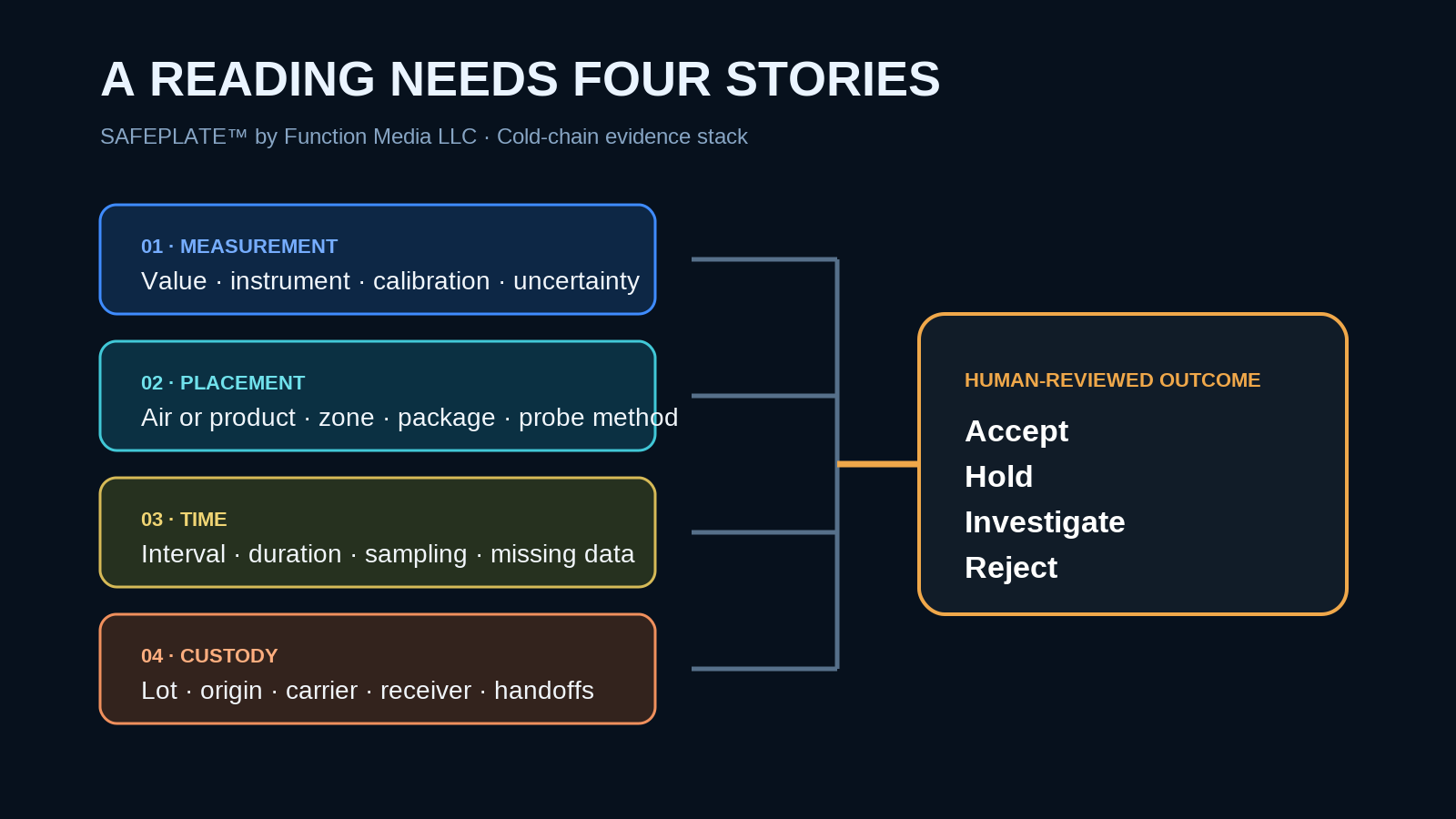
A useful temperature record needs at least four linked stories:
- Measurement: the value, unit, instrument, calibration status and uncertainty relevant to the use.
- Placement: the sensor’s physical relationship to the food, package, pallet, vehicle or storage zone.
- Time: the observation interval, clock source and duration of any excursion—not only a single timestamp.
- Custody: the lot, shipment, facility, carrier, receiver and handoffs that bound responsibility.
If any story is missing, the reading may remain useful as a signal, but it should not be presented as complete proof.
Placement can change the meaning of the same environment
Cold spaces are not perfectly uniform. Door openings, airflow, load density, defrost cycles, staging practices and sensor proximity to cooling equipment can produce different readings within the same room or vehicle.
A logger near an evaporator may understate conditions elsewhere. A probe touching ice or a cold wall may produce a value that does not represent the food. An ambient reading taken during unloading may spike without proving that product temperature crossed the same threshold. Conversely, a favorable cab display does not establish conditions at the warmest point inside a tightly packed load.
The evidence record should therefore preserve placement as structured context rather than burying it in a note. A photograph, zone identifier, package position, probe method or installation diagram can make the difference between a defensible measurement and a number that cannot be interpreted later.
This does not mean every shipment requires an elaborate sensor array. It means the measurement plan should match the decision it is expected to support.
Calibration is not a permanent property
Calibration establishes a relationship between an instrument and a reference under defined conditions. It does not make every future reading automatically correct.
NIST explains metrological traceability as a documented chain of calibrations connecting a measurement result to a reference, with each link contributing uncertainty. NIST also cautions that traceability attached to a calibration certificate does not automatically extend to every later measurement a user makes with that instrument.
For operations, that distinction matters. Instruments can drift, be damaged, be used outside their rated range or be installed incorrectly. A defensible record should connect the reading to the instrument identifier, calibration date, method, due date and any verification performed before or after use. If a device fails a post-use check, the system should identify which records may be affected rather than silently preserving their original confidence.
Calibration evidence should also remain separate from maintenance evidence. A replaced battery, repaired cable or firmware update may affect reliability without being a calibration event. Preserving those differences helps reviewers understand what is known and what still requires judgment.
An excursion is a duration, not a red dot
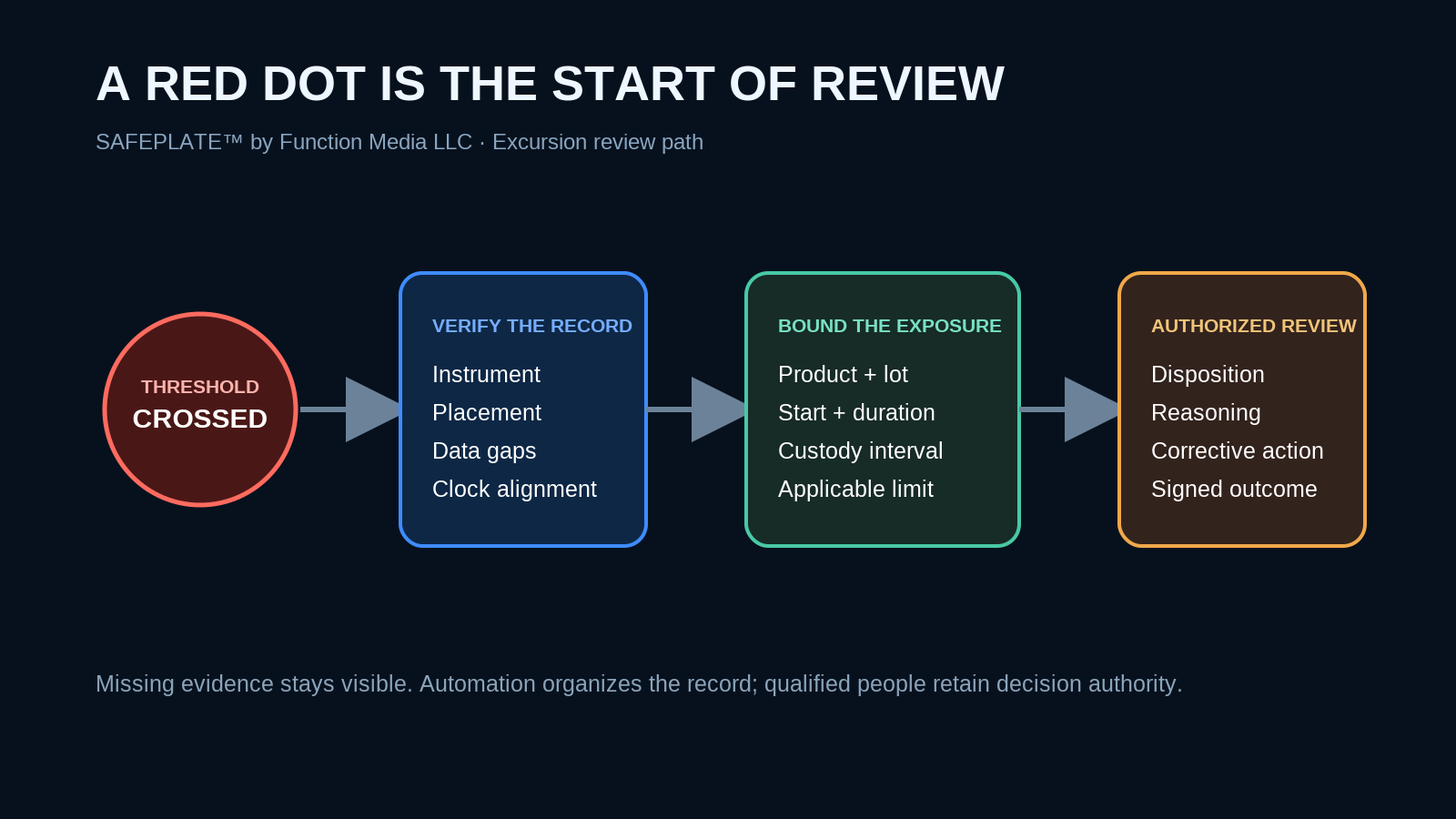
Many monitoring systems are designed to show that a threshold was crossed. That is important, but a threshold event is only the beginning of an assessment.
A review needs the start time, end time, highest or lowest observed value, sampling interval, missing readings, location, affected product, applicable specification and any corrective action. It should also distinguish the instrument’s alert threshold from a regulatory limit, product specification or organization-defined operating boundary. Those categories can overlap, but they are not interchangeable.
The shape of an excursion matters. A brief ambient spike during a door opening is different from a sustained rise across several sensors. A logger that stops reporting creates uncertainty; it does not prove conditions remained acceptable. A late upload can preserve historical readings while still delaying intervention.
The operational question is not simply, “Did the line turn red?” It is, “What happened, what product was exposed, for how long, how reliable is the evidence, and who is authorized to decide the disposition?”
Custody determines who could act
Temperature control crosses organizational boundaries. A producer may prepare the load, a carrier may transport it, a distribution center may receive it and a retailer or institution may store it. A reading without a custody interval can identify a condition without identifying when responsibility changed or who had the ability to intervene.
FDA’s Food Traceability Rule organizes certain records around Critical Tracking Events and Key Data Elements. Temperature records are not a substitute for those required records, and not every food or operation is covered in the same way. But the framework illustrates a broader systems lesson: evidence becomes more useful when it is tied to specific events, locations, lot identities and recipients.
For cold-chain intelligence, handoffs should preserve planned and actual times, seal status, instrument continuity, receiver acknowledgement and exceptions. If a carrier replaces a trailer, a logger is moved, a seal is broken or a load is staged unexpectedly, the record should show the transition rather than flattening the shipment into one uninterrupted line.
The system should preserve disagreement
Real evidence does not always align.
The vehicle display may show one condition while a receiving probe shows another. Two loggers may disagree. A shipment record may use a different clock. A product specification may require a stricter limit than a general operating policy. The temptation is to choose one reading and overwrite the rest.
A stronger system preserves the competing observations, their sources and the reason a responsible person relied on one interpretation. That makes correction possible later. It also prevents an automated summary from appearing more certain than the underlying record.
SAFEPLATE’s design direction is not to make disposition decisions autonomously. It is to help authorized people assemble the relevant evidence, see missing context, compare applicable boundaries and document the human-reviewed outcome.
What a reviewable cold-chain record should show
A decision-ready record should make the following visible without requiring a reviewer to reconstruct the shipment from separate inboxes and spreadsheets:
- product and traceability-lot identity where applicable;
- origin, destination and custody intervals;
- instrument and calibration record;
- measurement location and probe method;
- time source, sampling interval and data gaps;
- applicable product, operational or regulatory boundary;
- excursion start, duration, severity and spatial extent;
- photographs, seal records and receiving evidence where relevant;
- corrective action, product disposition and responsible authority;
- unresolved contradictions and reasons for uncertainty.
Not every field will be available in every setting. The system should make that absence visible. “Unknown” is often safer than an inferred fact that later appears authoritative.
Cold-chain intelligence begins where the chart ends
A chart can show change. It cannot, by itself, prove that the sensor represented the food, that the instrument remained reliable, that the lot identity was correct, that custody was continuous or that the resulting decision followed the applicable rule.
Those questions live around the measurement. They are what turn telemetry into evidence.
The cold chain is therefore not one temperature and not one uninterrupted line. It is a reviewable sequence of claims: this instrument measured this condition, in this place, during this custody interval, for this product, under this boundary, and an authorized person reached this documented conclusion.
That is the level of context institutions need when food safety, operational accountability and public trust depend on what the number is allowed to mean.
Stage note: SAFEPLATE™ is an early-stage platform under development by Function Media LLC. This article describes a design direction and general evidence principles. It does not claim regulatory approval, certification, customer deployment, validated performance or replacement of qualified food-safety professionals.
Working with Function Media: Function Media LLC is available for selected paid institutional pilots, purpose-built systems, sponsored development, licensing, integration and strategic partnerships. Learn more.