At 8:42 a.m., one cell in an attendance grid is still empty. That absence of data can look simple. It is not. The student may be on a delayed bus, in the nurse’s office, entering through another supervised location, present in the building but not yet marked in class, absent with a family message that has not reached the right person, or genuinely unaccounted for.
The blank cell does not distinguish among those states. It only shows that the expected record has not been completed. Treating the blank as an answer collapses uncertainty too early. Treating it as an operational exception creates a more responsible question: what is known, what remains unresolved, who owns the review, and what evidence will close it?
This distinction matters because attendance is not merely a statistic produced at the end of a day. It is a sequence of observations, professional judgments and communications that begins before first period and may continue after the initial mark. A school operations system should help authorized people reconcile that sequence without pretending that every signal means the same thing.
The mark is one observation inside a larger day
A classroom attendance mark is important. It is also bounded. It can establish what a teacher or authorized staff member recorded at a particular time under a particular procedure. It does not automatically establish the student’s transportation status, location elsewhere in the building, family communication history, health context or reason for the discrepancy.
The same is true of other operational signals. A bus arrival does not prove classroom presence. A building-entry event does not prove instructional attendance. A family message does not prove that the message reached the staff member responsible for the record. A roster correction does not explain why the original state changed unless the reason and authority are preserved.
These states should remain distinguishable. When software flattens them into one mutable field, it becomes difficult to tell whether a record was entered late, corrected, overridden, inferred or confirmed through another source. A clean final value may hide a messy—and operationally important—path.
Unresolved is a valid state
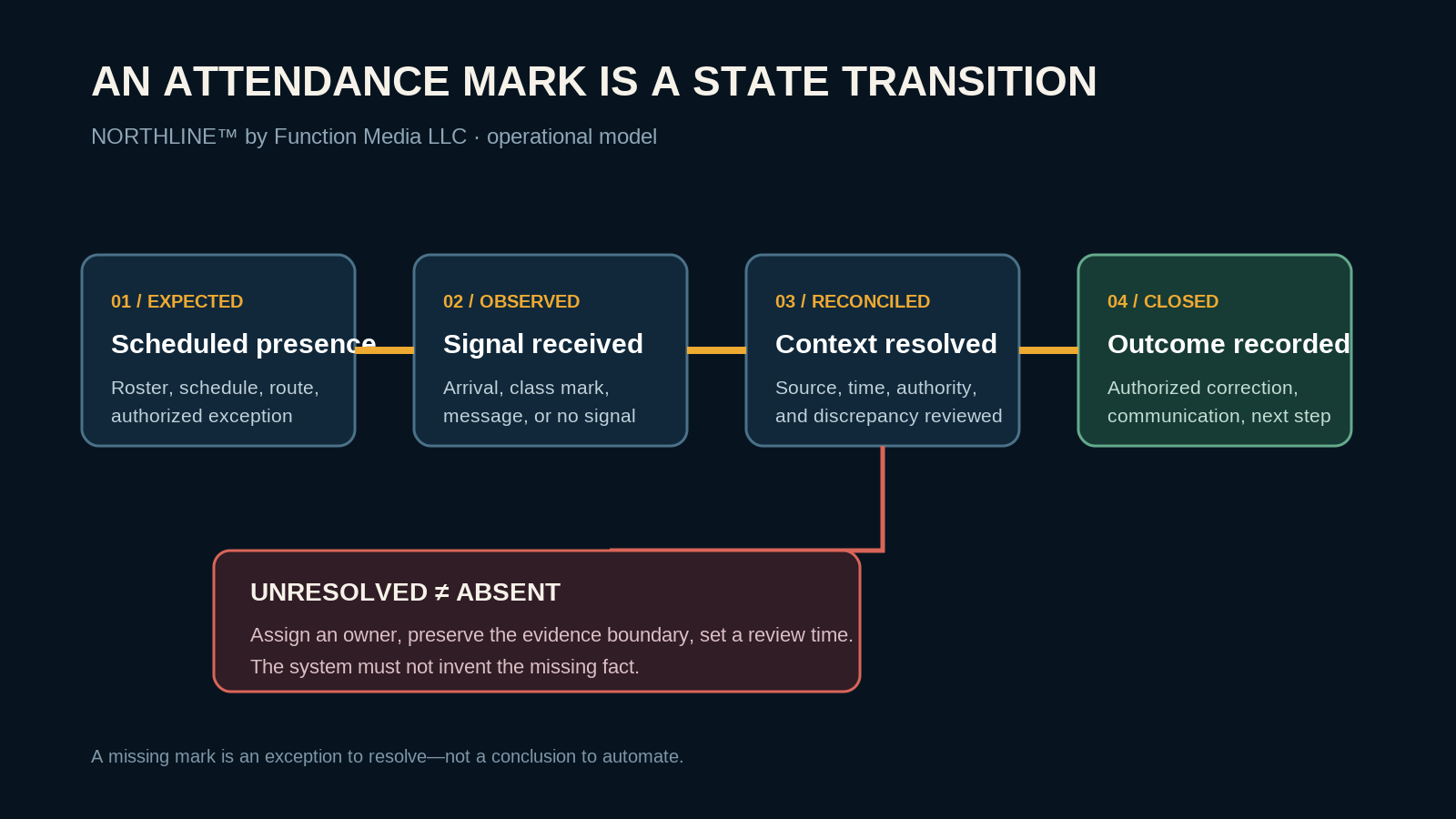
Institutional systems often reward completion. Empty fields look like defects, so designers create defaults, automatic fills or aggressive alerts. That pressure can be useful when it prompts review. It becomes dangerous when the system resolves uncertainty by inventing a fact.
“Unresolved” should be a visible operational state with its own owner and review window. It says that the expected observation is missing or contradictory, not that the system knows why. It can carry the last verified point, the relevant schedule, the source status of each signal, and the time by which an authorized person should review it.
This approach also reduces noisy escalation. Not every late mark is an emergency. Some are routine delays, device failures or expected variations. The system should help staff distinguish a short-lived recording gap from a condition that requires outreach, support or escalation. That judgment belongs to authorized people operating under school policy—not to an opaque inference.
Attendance improvement begins with causes, not labels
The U.S. Department of Education’s current attendance resources emphasize that chronic absenteeism can reflect multiple, interconnected causes and point schools toward strategies such as early-warning systems, family engagement, mentoring and tailored support. That framing is important. An attendance pattern is evidence that deserves attention; it is not, by itself, a diagnosis of a student or family.
Research resources from the Institute of Education Sciences also describe text-based family outreach as one evidence-based practice for supporting attendance. The useful systems lesson is not “send more messages.” It is to preserve the difference among a message generated, sent, delivered, acknowledged and acted upon. A notification count is not the same as a completed communication loop.
When an exception repeats, the school may need a broader review: transportation reliability, health barriers, schedule conflicts, accessibility needs, family circumstances or another locally determined cause. Technology can organize the pattern and the supporting evidence. It should not assign motive, blame or intervention without the authorized human process that gives those actions legitimacy.
Privacy boundaries belong inside the workflow
Resolving an attendance exception may involve information that different roles should not all see. A transportation coordinator may need route and arrival context. A teacher may need the classroom status. A family-facing staff member may need communication history. A principal or designated attendance lead may need a broader operational view. None of that means every participant should receive every record.
Federal student-privacy guidance explains that access to education records under the school-official exception depends on legitimate educational interest, and agencies must use reasonable methods to ensure officials see only records connected to that interest. The design implication is concrete: role, purpose and minimum necessary context should shape each view.
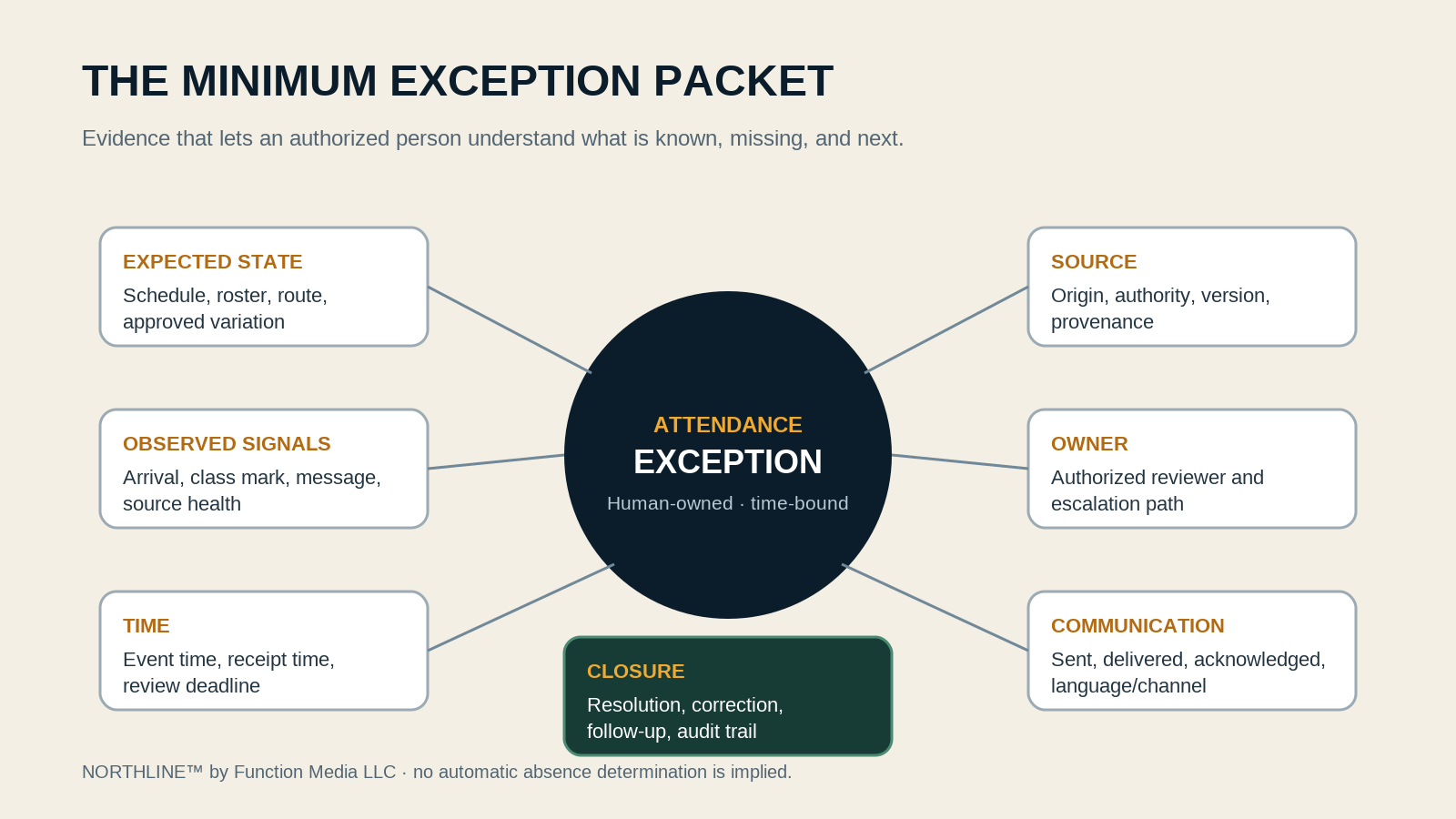
That is why the exception packet should be structured rather than copied wholesale. Each participant can receive the evidence needed to perform a professional responsibility while the system preserves the larger audit trail under appropriate controls. Privacy is not a final permission screen added after the workflow. It is part of the workflow’s architecture.
Closure must be more than a changed value
An attendance record can be corrected without the operational exception being closed. Closure should answer several questions: Who resolved the discrepancy? Which evidence supported the resolution? Was a family communication required, and what was its status? Did the case reveal a recurring process issue? Is follow-up assigned? Was the original value preserved in an audit history?
This does not require a sprawling case-management process for every late mark. The workflow should be proportional. Routine corrections can close quickly with a reason and authorized source. Repeated or higher-consequence exceptions can carry additional review. The design goal is not bureaucracy. It is enough durable context to prevent the final value from erasing the operational lesson.
That durable context can also improve systems without turning individual students into training material. Schools can examine aggregated, governed patterns in route delays, submission timing, device availability, acknowledgment gaps or recurring workflow bottlenecks. Any analysis involving protected information should remain subject to authorization, purpose limitation, access controls and applicable policy.
What NORTHLINE is being designed to support
NORTHLINE™ by Function Media LLC is being developed around the information environment connecting transportation, attendance, schedules, family communication, student services, safety and district operations. The design direction is to help authorized teams see relationships among evidence while preserving role boundaries, source lineage and human responsibility.
For attendance exceptions, that means a system should be able to show the expected state, time-stamped observations, unresolved contradictions, assigned owner, review window, communication status and recorded closure. It should make stale or unavailable sources visible. It should distinguish a staff-entered fact from a system-generated prompt. It should never present an automated guess as a verified attendance decision.
Function Media’s public materials describe research, product direction and technology under development. They do not claim that NORTHLINE is approved, adopted or deployed by a school system unless that status is independently established.
The cell is small. The responsibility is not.
A missing mark looks like empty space in a grid. Operationally, it sits at the intersection of time, place, communication, professional authority and student support. A useful system makes that intersection reviewable without turning uncertainty into accusation or exposing more information than the work requires.
The goal is not to make the attendance screen look complete. The goal is to help authorized people understand the school day accurately, respond proportionately and preserve the evidence behind the final record.
Sources and further reading
- U.S. Department of Education — Supporting Student Attendance and Engagement
- Institute of Education Sciences — Chronic Absenteeism
- IES — Impact Evaluation of Parent Messaging Strategies on Student Attendance
- U.S. Department of Education — Reasonable methods and legitimate educational interest under FERPA