
Two district reports can display “attendance rate” in the same typeface, on the same screen and for the same school—while counting different students, using different calendars, closing at different times and treating late corrections differently.
The disagreement is not necessarily a software bug. It can be a definition failure. A label survived while the meaning underneath it changed.
A district dashboard therefore needs more than a catalog of charts. It needs a definition registry: a governed, versioned record that explains what each metric means, where it comes from, how it is calculated, who owns it and when the definition changed.
A familiar label can hide an unstable measure.
District operations are full of compact labels: enrollment, chronic absence, device ready, open work order, response time, route on time, case closed. Each label compresses a set of choices.
For attendance, the choices might include the student population, instructional calendar, partial-day rule, excused-status treatment, enrollment boundary and cutoff for late updates. For device readiness, they might include whether a device is assigned, charged, patched, connected, repaired or merely present in inventory.
If those choices change without a definition version, the chart can remain visually consistent while the series stops being comparable. A rise may reflect a policy change rather than an operational change. A school comparison may reflect different source completeness rather than different performance.
The metric needs a meaning before it needs a chart.
A dashboard should resolve a governed definition, not ask the audience to infer one from the label.
The registry is the semantic contract.
A useful definition registry does not freeze language forever. It makes the current meaning explicit and preserves earlier meanings when policy, calendars, systems or operational needs evolve.
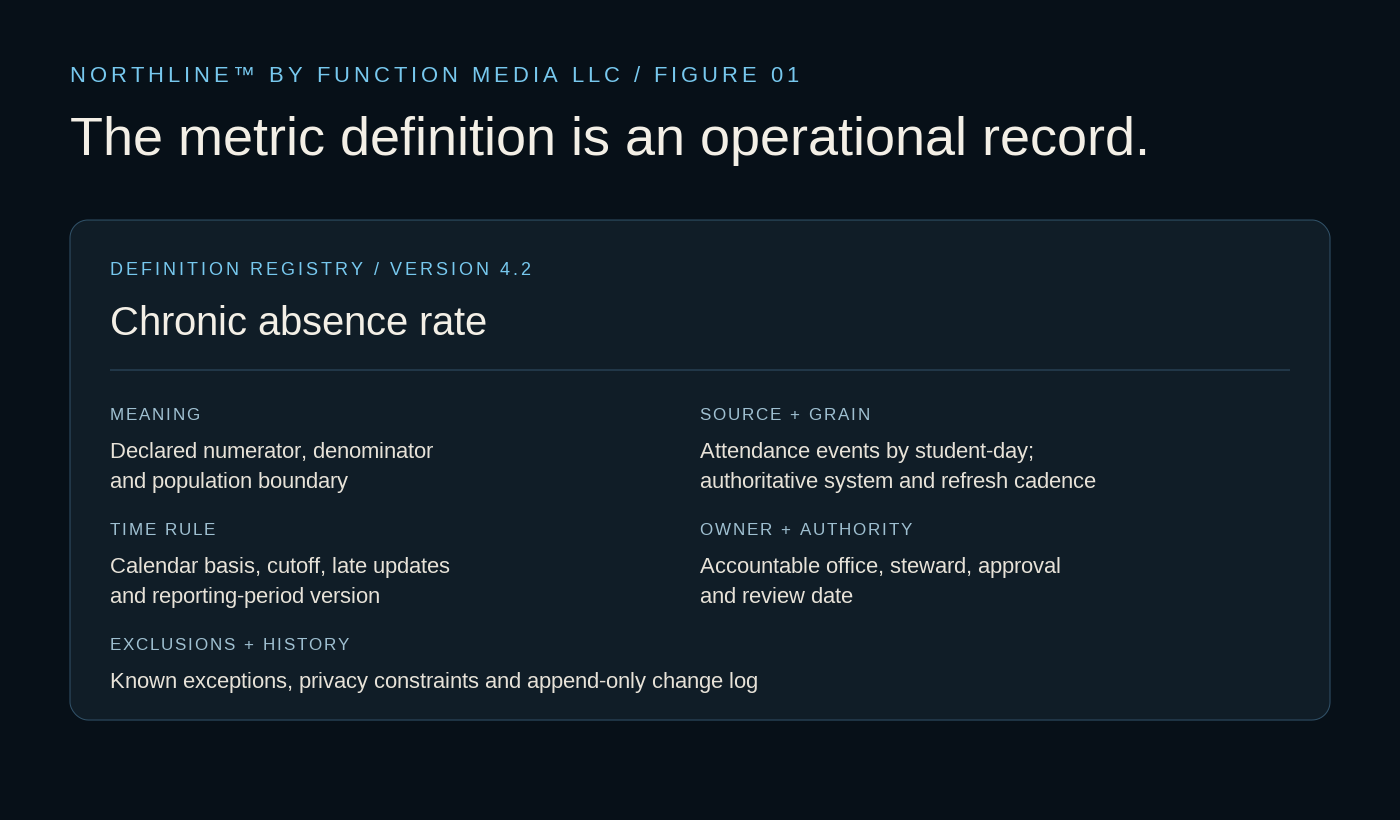
The preferred label, plain-language definition and the decision or question the metric is intended to support.
The unit being counted and the boundaries of the population: student-day, device, route, case, building, reporting period or another declared unit.
The authoritative system or evidence stream, its refresh cadence, known latency and the conditions under which a secondary source may be used.
The applicable calendar, cutoff, observation window, late-update policy and reporting-period version.
The numerator, denominator, status rules, null handling, known exceptions, privacy constraints and quality thresholds.
The accountable office, data steward, approving authority, review date and escalation path for disputed meaning.
What changed, why it changed, who approved it and which historical or future results use the new definition.
A data dictionary is necessary but may not be sufficient.
Education data standards and dictionaries provide shared vocabulary, element definitions and interoperability structures. The Common Education Data Standards initiative supports a common language for education data and offers tools including a data dictionary. The NCES Forum Guide to Data Governance treats governance as an organizational process involving decision rights, policies, standards and accountability.
A district metric registry can build on those resources while adding local operational controls. The standard may define an attendance element; the district still needs to declare which event states enter a particular indicator, which calendar version applies, which late corrections are accepted and who approves a change.
This distinction matters because a dashboard metric is usually derived. It combines source elements, local policy, a time boundary and calculation logic. Its definition must therefore connect the standardized vocabulary to the actual calculation and decision context.
The result should carry the definition version.
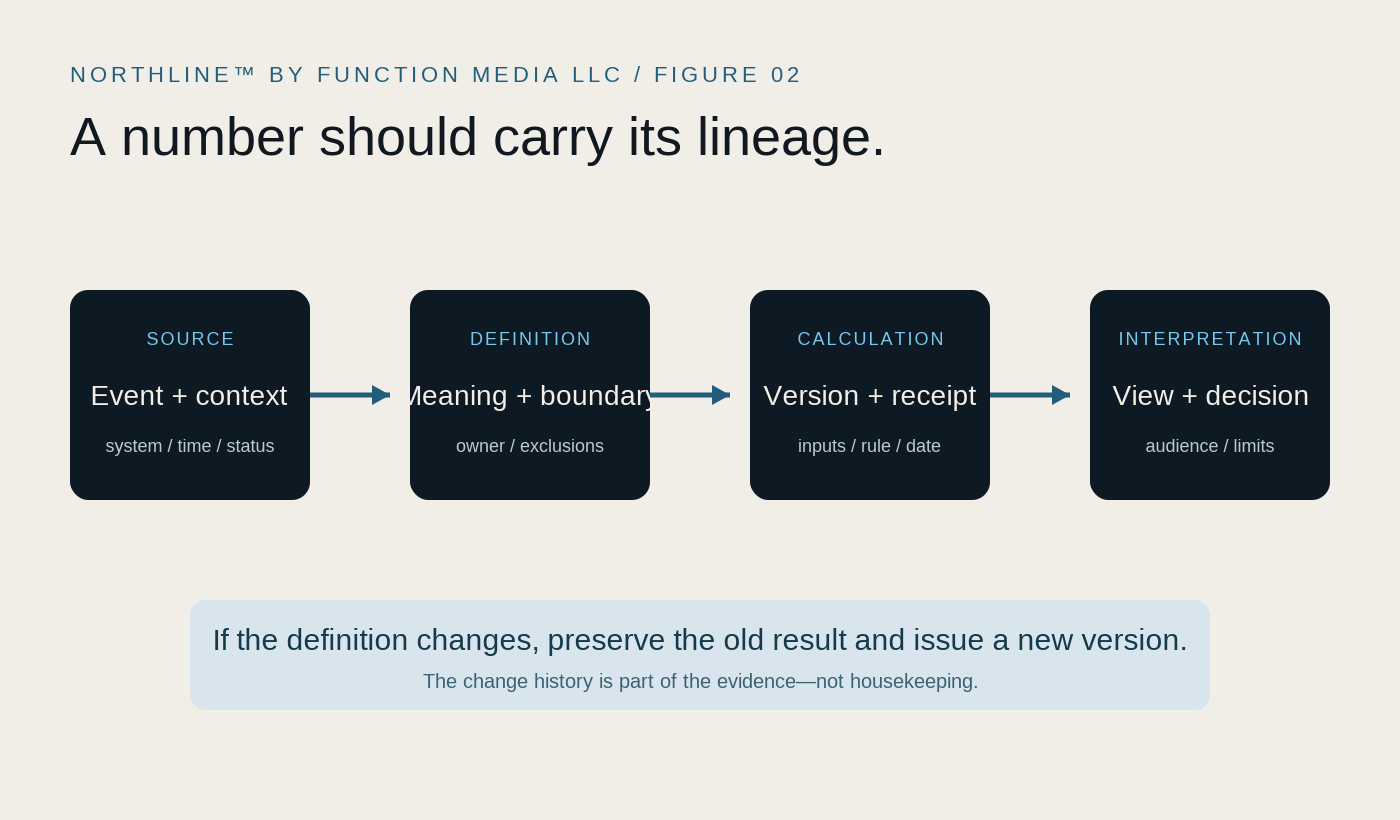
Once a definition exists, every published result should retain a reference to the exact version used. A metric value is not fully identified by name, subject and period alone. It also needs the definition version and calculation receipt.
The receipt can record source snapshots, query or rule version, calendar version, cutoff, calculation time and result status. That makes reproduction possible without pretending every source will remain unchanged forever.
Corrections should not erase what people saw.
District data changes. Attendance events arrive late. Enrollment records are corrected. A calendar closes unexpectedly. A device state is revised after repair verification. The goal is not to prevent those changes; it is to preserve their relationship to the earlier record.
When new evidence changes a result, the workflow can issue a new calculation receipt and identify the earlier result as superseded. When a definition changes, the registry can state whether historical periods will be recalculated and whether the recalculated series is directly comparable with contemporaneous reports.
This protects two kinds of truth: the best current interpretation and the historical fact of what a decision-maker actually saw at the time. A system that silently rewrites the past may provide a cleaner chart while destroying institutional memory.
Ownership is part of meaning.
Metric disputes often look technical but involve authority. Who decides whether a late absence counts? Who approves a new device-readiness threshold? Who can change a service-response clock? The registry should name that decision path.
Technical teams can implement rules, but they should not silently create policy through queries. Program owners can define operational intent, but they need data stewards to expose source limitations and side effects. Governance gives those roles a visible place to meet.
The NCES Forum Guide to Data Governance emphasizes responsibilities and processes for managing data as an organizational asset. CEDS governance resources likewise distinguish governance from a one-time technical project. For dashboard definitions, that means ownership, review and change control must be durable parts of the system.
Metadata and provenance are not decoration.
NIST describes metadata as information about the characteristics of data, and provenance as the chronology of ownership, custody or location. Applied to district metrics, those ideas support a straightforward control: keep the data about the number with the number.
A reviewer should be able to move from a chart to its definition, from the definition to its source and logic, and from a published value to its calculation receipt. The interface can remain concise. The evidence beneath it should not disappear.
That approach also supports accessibility and public explanation. Plain-language definitions, visible reporting dates and honest limitations help audiences understand what a measure can and cannot establish without requiring them to interpret a database schema.
A definition registry changes the dashboard’s job.
The dashboard stops being the final authority and becomes a view into governed records. Its job is to present a metric clearly, surface the definition version, reveal material warnings and provide a route to the underlying explanation.
That can lead to practical interface choices: a visible “defined as” link; a last-calculated timestamp; a badge when a definition changed; a distinction between preliminary and final results; and an explanation when comparison across periods is limited.
These controls do not make the interface heavier. They make its confidence proportionate to the evidence.
A design principle for NORTHLINE™.
NORTHLINE™ by Function Media LLC is being developed as an evidence-centered district information infrastructure concept. Its public systems posture is that operational measures should preserve meaning, source, timing, ownership and change history—not merely display current values.
This article does not claim a deployed customer system, district partnership, measured outcome, certification or autonomous authority. It describes a systems-design principle: when an institution depends on a metric, the definition must become a versioned record that can survive the dashboard built on top of it.
Public sources
Related: A Missing Attendance Mark Is an Operational Exception
Related: A School Schedule Is a Dependency Map
Related: The Student Record That Isn't One Record