Published by Function Media LLC · Author: Illya Knight, Founder & Managing Member · VERISCOPE™ by Function Media LLC
VERISCOPE™ by Function Media LLC · Knowledge Center
The Review Window Is a System Component
Evidence has two clocks: when a condition was observed, and how long that evidence can still change an authorized decision.

Source provenance: original Function Media LLC analysis describing a development direction for VERISCOPE™. No independent external factual source set is asserted. No customer deployment or measured performance is claimed.
Operational systems often treat time as metadata. An event occurred at 09:14. A record was updated at 09:17. An analyst opened the case at 09:42. The timestamps are preserved, but the system rarely explains what those minutes changed.
That omission matters because evidence does not arrive in a vacuum. It arrives while a decision is still possible, after one action has become irreversible, before a threshold is crossed, or after a response has already lost most of its value. A fact can be accurate and still arrive too late to support the decision it was meant to inform.
The review window is the interval in which evidence can still change an authorized action. It is not merely a deadline placed beside a task. It is part of the operating environment: a boundary shaped by consequence, reversibility, authority, evidence quality, and the cost of waiting.
If a system records the signal but ignores that window, it may preserve history while failing operations.
A timestamp is not a decision window
Timestamps answer important questions: when a source was observed, when a record changed, when a model produced an output, and when a person reviewed it. They support chronology and accountability. But chronology alone cannot explain whether a record was actionable.
Consider an alert that identifies a possible inconsistency. At the moment it appears, an operator may still be able to pause a workflow, confirm the source, notify an authorized reviewer, or choose a reversible response. Twenty minutes later, the same alert may describe a completed transaction, a departed vehicle, a published notice, or a closed operational route. The data has not necessarily become false. Its operational value has changed.
A useful system therefore has to preserve at least two kinds of time:
- Evidence time: when the underlying condition was observed or documented.
- Decision time: how long an authorized person can still use that evidence to change the outcome responsibly.
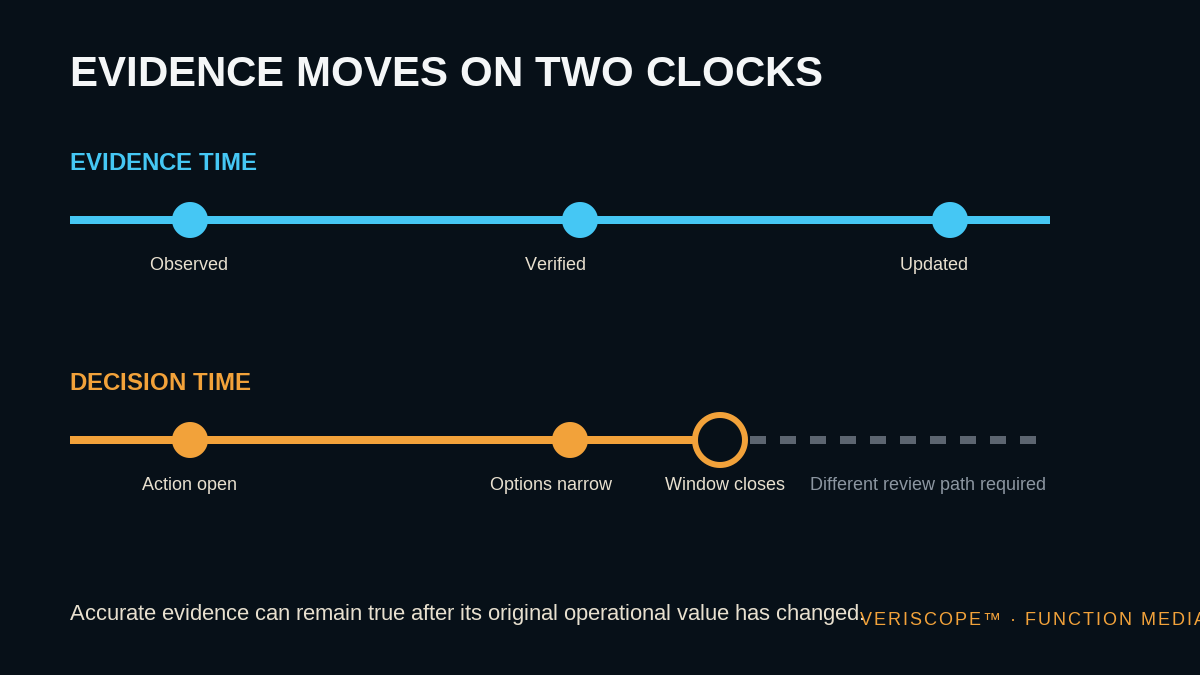
Those clocks may not move together. A source can be current while the decision window is nearly closed. An older source can remain authoritative if the relevant condition has not changed. A fast signal can be too weak for a consequential action, while a slower verification can still be useful for a reversible one.
This is why “real time” is not a complete design requirement. The more useful requirement is: real time for which decision, under which authority, with what evidence, and before what becomes irreversible?
The window changes with the action
There is no universal review window. The right interval depends on the action under consideration. A system may support several possible responses to the same signal: observe, request another source, place a temporary hold, route the matter to a designated reviewer, issue a limited internal notice, correct a record, authorize a change, or escalate under an established procedure.
Each response carries a different evidence threshold and a different cost of delay. Monitoring may remain useful for hours. A temporary hold may need to occur within minutes. A public or consequential action may require stronger verification, even when that means waiting.
The design problem is not to make every decision faster. It is to make the relationship between time, evidence, authority, and reversibility visible.
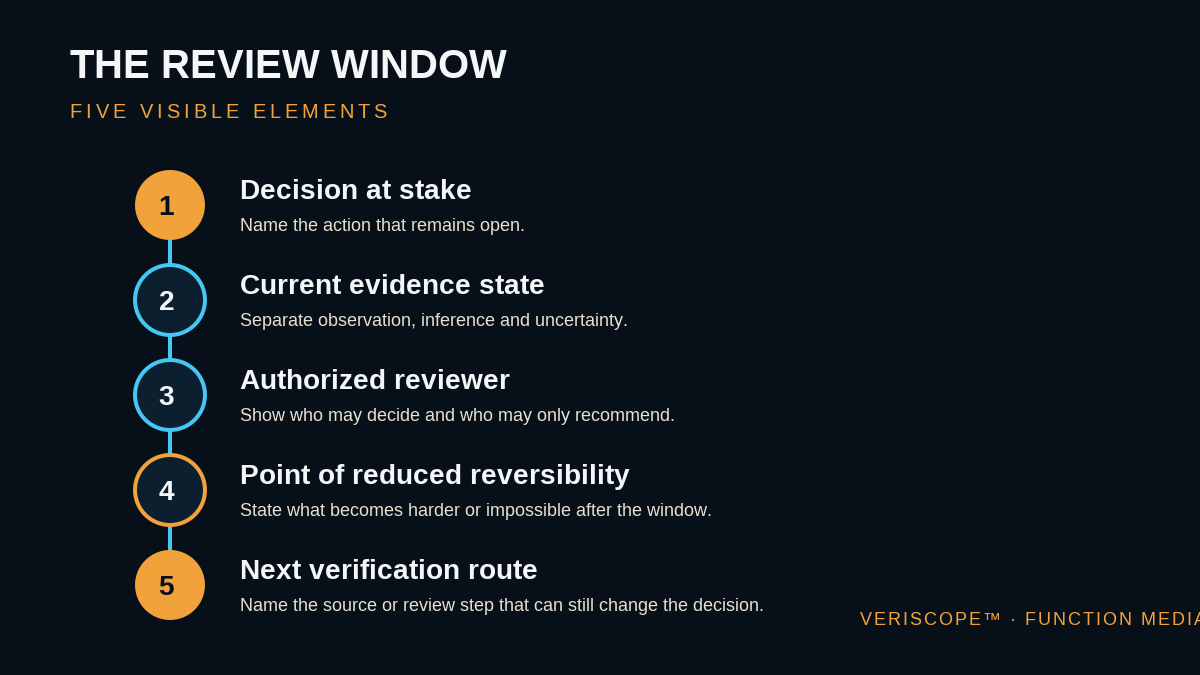
A review window needs five visible elements
VERISCOPE™ by Function Media LLC is being developed around evidence-centered operational intelligence. In that direction, a review window should not exist as an invisible timer. It should be represented as a structured part of the case.
1. The decision at stake
The system should name the decision that remains open. “Review this alert” is too vague. A reviewer needs to know whether the open question is to pause, verify, notify, authorize, correct, or escalate. Naming the decision prevents an interface from confusing attention with action.
2. The current evidence state
The case should separate what has been observed from what has been inferred. It should identify source provenance, freshness, contradictions, missing records, and the scope of uncertainty. A high-confidence summary is not a substitute for the sources that made the summary possible.
3. The authorized reviewer
The system should show who may make the decision and who may only recommend, prepare, or acknowledge it. An escalation without a defined authority path merely transfers ambiguity to another person.
4. The point of reduced reversibility
The interface should identify what changes when the window closes. Does a transaction become final? Does a notification leave the organization? Does a vehicle depart? Does a temporary condition become harder to correct? Reversibility is often more useful than urgency as a design signal.
5. The next verification route
If the evidence is incomplete, the system should name the next useful source or review step. “More information needed” does not tell an operator what would materially change the decision. The route should be realistic within the remaining window.
The interface should show decay, not manufacture certainty
Many systems display a stable status badge even while the circumstances underneath it change. A green label remains green until someone manually updates it. A confidence score stays fixed after the source has aged. An alert remains open without explaining whether its most useful response is still available.
A better interface can use explicit states: window open, verification due, reversibility narrowing, window closed, or window reopened. These states do not tell a person what to decide. They make the operating conditions of the decision inspectable.
AI should help prepare the window, not own it
AI can assist by organizing source records, identifying missing evidence, comparing timestamps, highlighting contradictions, and preparing a review packet. It can estimate that a source may be stale or that an operational threshold may be approaching.
But a model should not silently define the authority, consequence, or acceptable evidence threshold for a consequential action. Those boundaries belong to the institution, the operating procedure, the law or policy where applicable, and the authorized people responsible for the outcome.
The system should preserve a visible distinction between what the model detected, what the evidence supports, what the governing rule permits, what remains uncertain, and what an authorized person decided.
What a complete decision record should preserve
When the review ends, the system should not save only the final status. It should preserve the window in which the decision was made:
- the decision question;
- the evidence available at that time and evidence that arrived later;
- the governing instruction or authority state;
- the responsible person or role;
- the reversible options that remained open;
- the reason for acting, waiting, or escalating;
- the time at which the original window changed or closed; and
- the correction or appeal route, where appropriate.
This record helps future reviewers distinguish a decision that was reasonable at the time from one that merely looks reasonable after the fact. If teams repeatedly receive important evidence after the window closes, the problem may not be reviewer performance. The source, routing, ownership, or workflow design may be wrong.
Time belongs inside the evidence model
Operational intelligence is not only about finding the right record. It is about making the record usable while a responsible decision is still possible. That requires systems to treat time as more than chronology. The review window should travel with the evidence, the authority path, the available actions, and the limits of what the system knows.
The goal is not to turn every decision into a race. It is to prevent a system from presenting an expired opportunity as an active one—or a fast signal as if it were already sufficient.
The review window is a system component because evidence, authority, and consequence all change across it. When that window becomes visible, operators can act with greater clarity, reviewers can understand what was possible at the time, and institutions can improve the route from signal to accountable decision.
Stage note: VERISCOPE™ is a technology under development by Function Media LLC. This article describes a design direction and general evidence principles. It does not claim government approval, certification, customer deployment, validated performance, or replacement of authorized professional judgment.
About Function Media LLC: Function Media LLC develops evidence-centered applied systems for complex operational environments. Illya Knight is Founder & Managing Member; Shea Johnson is a co-founder. VERISCOPE™, SAFEPLATE™, and NORTHLINE™ are presented as technologies under development unless a specific deployment or adoption is expressly documented.
Working with Function Media: Function Media considers selected paid institutional pilots, purpose-built systems, sponsored development, licensing, integration, and strategic partnerships. Learn more.