
The security boundary changes when an AI system can invoke a tool, query a protected repository, modify a configuration, open a ticket, send a message or coordinate another agent. At that point, the model is not merely producing language. It is participating in an operational chain.
That shift is now visible in the security strategies of major technology firms. Microsoft’s November 2026 security announcements describe AI agents as “new insiders” and emphasize discovery, dedicated identity, task-scoped permissions, runtime risk assessment and containment. Google Threat Intelligence reports that adversaries are moving beyond basic prompting toward autonomous multi-agent frameworks and automated exploitation pipelines. Google’s identity guidance similarly treats an agent as a first-class principal rather than a generic service account.
These are product announcements and threat-intelligence findings from their publishers, not proof that every organization has the same exposure. But they point in the same direction: once software can act with delegated authority, observability alone is not enough. Institutions need to know who—or what—acted, under which authority, against which evidence, and with what path to stop or reverse the action.
Identity must belong to the agent
A shared credential can authenticate a connection without establishing accountability. If a user, an agent and several automated services all operate through the same account, the record may show that the credential was accepted while concealing which actor selected the operation.
A dedicated agent identity creates a control surface. It lets policy distinguish the agent from the human who authorized a task, the developer who configured it, the service that executed it and the reviewer who accepted the result. It also makes revocation precise. Security teams can constrain one agent without disabling an entire workflow or pretending the user performed every machine-generated step.
The agent receives a stable, reviewable identity distinct from a person and from a generic service account.
The record preserves who initiated the task, what outcome was authorized and how long the delegation remains valid.
Policy evaluates the resource, tool, operation, risk state and surrounding evidence—not merely whether a token exists.
Authority can narrow or end without erasing the history of earlier authorized actions.
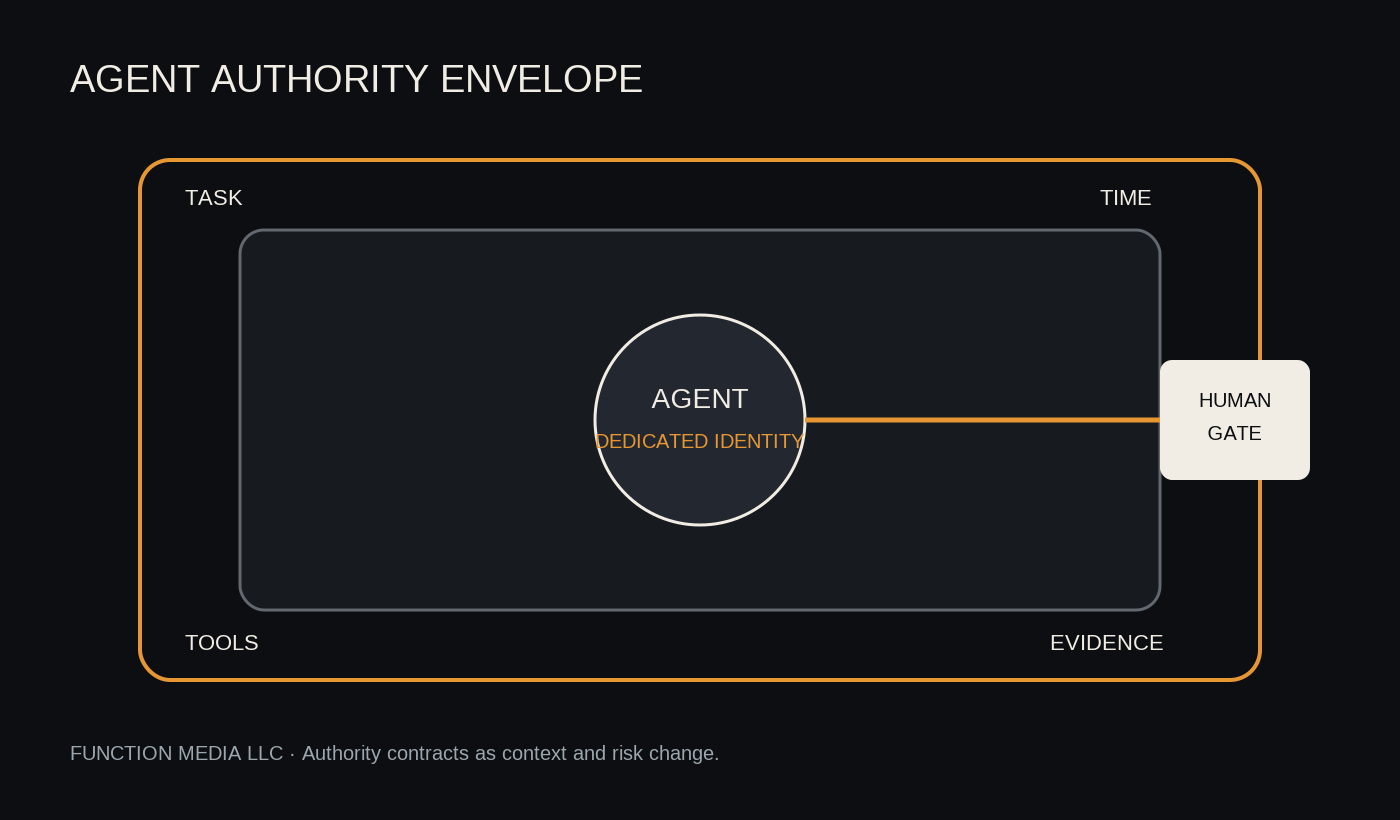
An agent should never inherit more authority than the task can justify.
Authentication answers whether an identity may enter. Authorization must still answer what it may do now.
Permissions should contract as risk changes
Traditional access models often grant a standing role and rely on the application to behave. Agentic systems complicate that assumption because the route from instruction to action is dynamic. The agent may interpret context, choose among tools, receive untrusted content and create additional steps that were not individually enumerated by the requester.
Microsoft’s current direction includes task-scoped, time-bound permissions and controls that can narrow access or require human approval as risk changes. Google describes agent-specific identities, centralized gateways and policy enforcement across agent-to-tool connections. The shared idea is more important than any single product: authority should be treated as a live envelope, not a permanent badge.
What is the agent trying to accomplish, and which actions are outside that purpose?
Authority should end when the task ends, not linger because cleanup was forgotten.
Allow only the systems, operations and data classes required for the authorized task.
These controls are especially important when the same agent can access private data, ingest untrusted content and communicate externally. Google’s 2026 risk report highlights that combination because prompt injection can turn a seemingly useful workflow into a path for autonomous disclosure. The defensive response is not merely a stronger prompt. It is a system boundary: identity, egress control, least privilege, runtime telemetry and intervention.
Every consequential action needs a receipt
Security logs often prove that an API request occurred. Operational evidence must preserve more. A useful action receipt binds the request to the agent identity, initiating authority, policy decision, tool invocation, evidence inputs, result, review state and any subsequent correction.
This matters because an agent’s explanation is not the same as a system record. A fluent summary can omit a denied tool call, flatten uncertainty or describe intent more confidently than the execution trace supports. The receipt should be assembled from control-plane events and preserved source references, not generated afterward as a narrative.
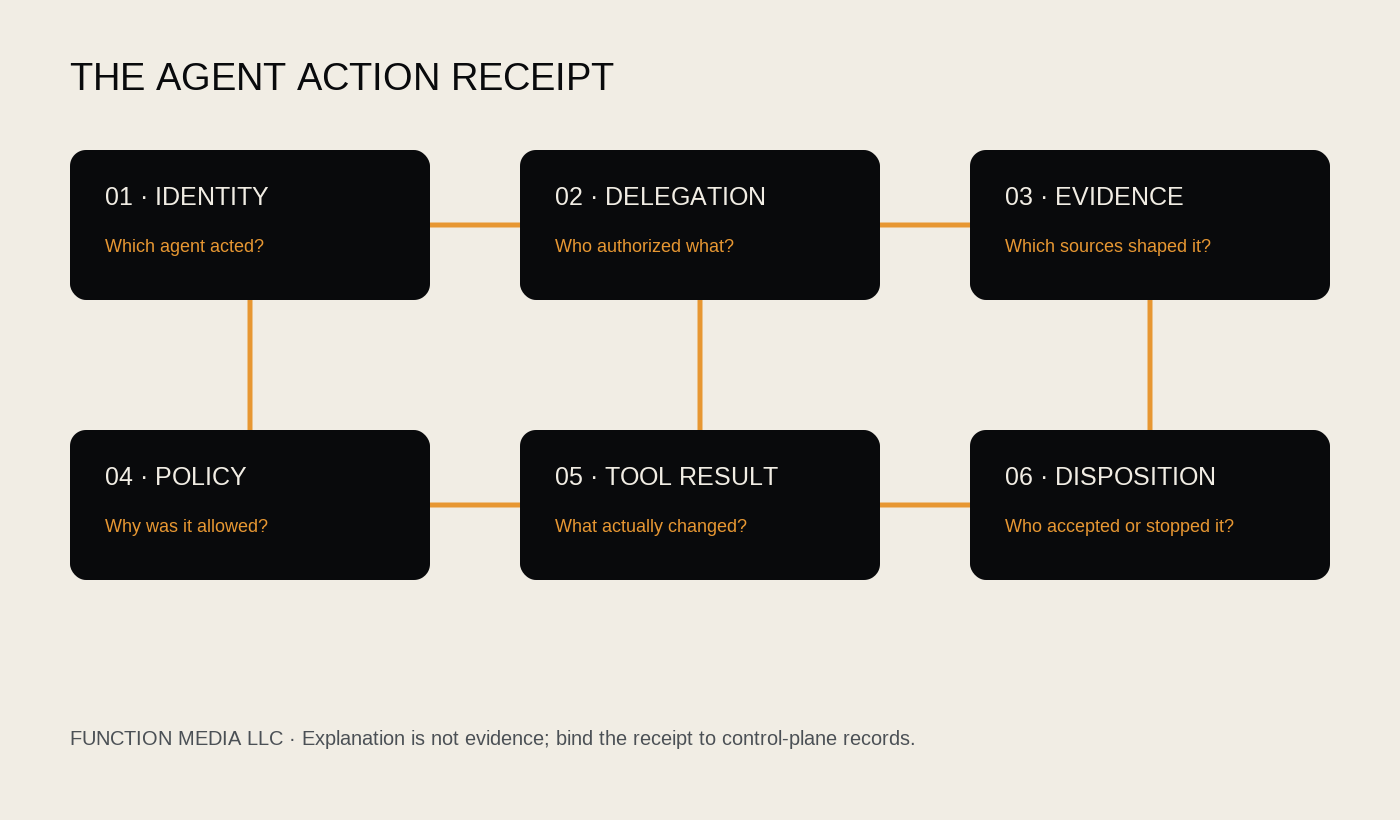
A minimum receipt should answer six questions: Which agent acted? Who or what delegated the task? Which policy authorized the operation? Which evidence shaped the choice? What changed in the external system? Who reviewed or accepted the result? If one answer is missing, the gap should remain visible.
Human review is a control point, not a slogan
“Human in the loop” becomes weak language when the loop has no defined moment, authority or evidence package. A reviewer who receives a confident summary after the change is committed may be performing acknowledgment rather than approval.
Review should be placed where consequence changes. Low-impact, reversible retrieval may proceed automatically. A sensitive disclosure, privilege expansion, destructive change or external commitment should cross a stronger boundary. The reviewer should see the proposed action, supporting evidence, material uncertainty, policy basis and reversal path before authorization.
The institution also needs a stop condition. Unexpected resource access, first-time contact with a sensitive repository, tool sequences outside the declared task, repeated denied operations or unexplained egress can justify narrowing permissions or suspending the agent. Intervention must be technically available before it is procedurally promised.
From AI safety to operational accountability
Model safeguards matter, but many real institutional risks live outside the model. Credentials, APIs, connectors, queues, approval gates, data boundaries and audit records determine what an agent can actually change. The operational system therefore needs controls that remain effective even when the model is mistaken, manipulated or simply surprising.
Function Media LLC develops evidence-centered systems concepts for consequential environments. VERISCOPE™ by Function Media LLC represents the operational-intelligence direction within that portfolio; SAFEPLATE™ by Function Media LLC and NORTHLINE™ by Function Media LLC apply related evidence and accountability principles in food-safety and K–12 operating contexts. This article describes design principles and public security developments, not a claim that every capability discussed is deployed or independently validated.
The next generation of AI security will be measured by more than whether a model refuses a harmful sentence. It will be measured by whether institutions can identify the acting system, bound its authority, observe its behavior, preserve evidence of each consequential step and intervene before an automated mistake becomes an institutional fact.
Sources and current context
- Microsoft Security — Security for the agentic era (17 Nov 2026)
- Microsoft Security — What’s new in Microsoft Security: November 2026
- Google Threat Intelligence — Agentic threat activity crosses a significant threshold (16 Nov 2026)
- Google Cloud / Mandiant — AI risk and resilience in 2026
- Google Cloud — IAM security, governance and runtime defense
Working with Function Media: selected paid institutional pilots, purpose-built systems, sponsored development, licensing, integration and strategic partnerships.
Explore partnership pathways →