
A system can be correct and the outcome still be wrong.
Technical teams are trained to inspect components: whether an API responded, a database committed, a model produced a score, or a notification was sent. Those checks matter. They also stop one layer too early.
Institutional work is composed of transitions. A source record becomes an observation. An observation becomes a finding. A finding becomes a review task. A review becomes a decision. The risk accumulates not only inside each stage, but between them. That is where definitions drift, caveats disappear, and provisional states harden into apparent facts.
The payload may arrive intact while the meaning arrives damaged.
Designing for handoffs means treating context as part of the record, not as decoration around it. Provenance, confidence, access rules, review state, and responsible ownership should travel with the information they qualify. They should remain inspectable after the moment has passed.
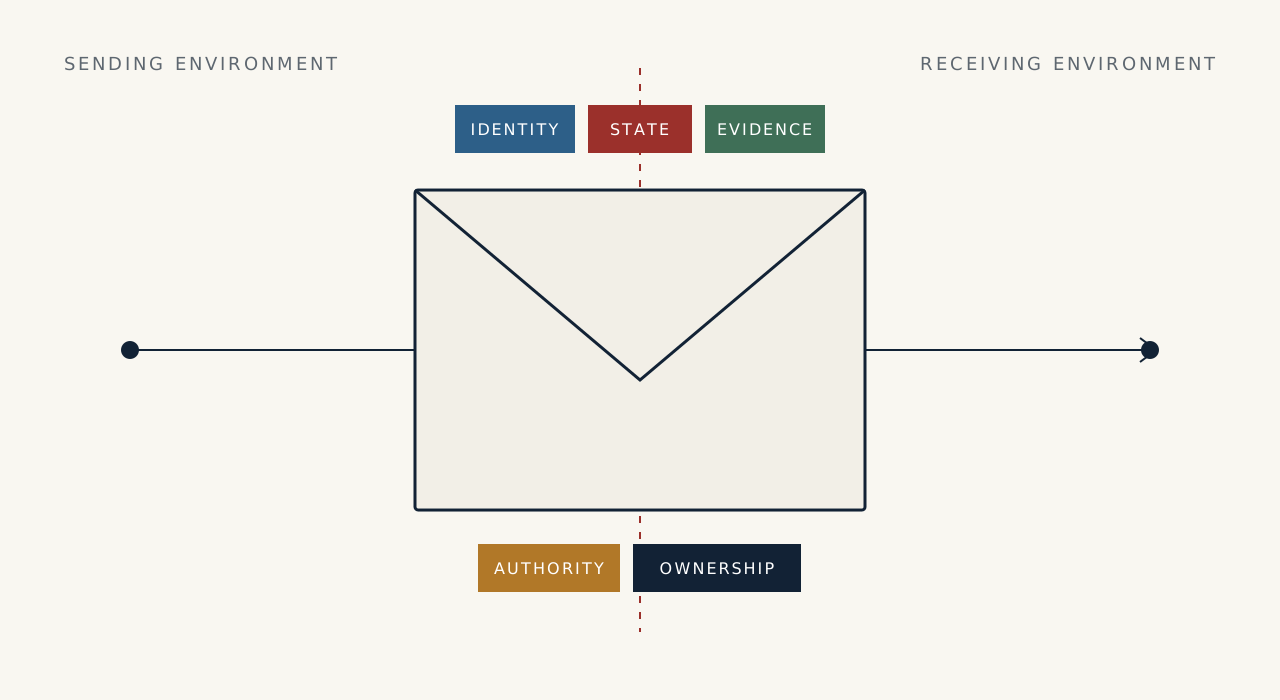
Four verbs for a better handoff
Attach
Attach the context needed to interpret a signal: source, timestamp, identity basis, confidence, policy constraint, and unresolved exceptions. A recipient should not have to reconstruct the conditions of the sender’s judgment from memory.
Preserve
Preserve the distinction between original evidence, derived information, and human interpretation. When these layers collapse into one field, later reviewers cannot tell what was observed, what was inferred, or what was decided.
Declare
Declare the state and authority of the work. Is this an alert, a hypothesis, a reviewed finding, or an approved action? Who is permitted to move it forward? Clear state prevents urgency from masquerading as certainty.
Acknowledge
A transfer is not complete because a message was sent. It is complete when the receiving role accepts custody—or rejects it with a reason. Acknowledgment creates an operational boundary that can be audited and improved.
VERISCOPE™
Regulatory and operational intelligence depends on evidence retaining its source, relevance, and review state as it crosses analytical and professional boundaries.
Explore the domain →SAFEPLATE™
Food-safety intelligence turns on chain of custody: lot, facility, laboratory, buyer, and geographic context must remain connected as response responsibility moves.
Explore the domain →NORTHLINE™
District operations require information to move among attendance, transportation, safety, and leadership without losing the student, route, exception, or accountable reviewer.
Explore the domain →The shared technical spine
Function Media develops distinct mission systems on a common engineering discipline. Multi-source data is ingested and normalized without erasing where it came from. Identity and entity resolution connects records while preserving the basis of a match. Evidence and knowledge graphs organize relationships with provenance and lineage intact. Confidence-aware reasoning separates a signal from a conclusion. Role-based access limits what each participant may see and do. Human review remains required at consequential moments, and the resulting history is designed to be durably auditable.
Those capabilities are not a promise that every decision becomes automatic. They are an argument for the opposite: when institutions use automation to organize complex information, the human decision should become more traceable, more contestable, and better supplied with evidence.