
The model produced a risk score on Monday. A sample result arrived Thursday. A corrective action changed the process on Tuesday. A later investigation revised the lot boundary. When, exactly, should the prediction be judged—and against which outcome?
Without an answer fixed in advance, almost any prediction can be made to look more useful after the fact. Teams can choose the most favorable time horizon, exclude unresolved cases, substitute an operational action for an outcome, or score against evidence that was not available when the prediction was made.
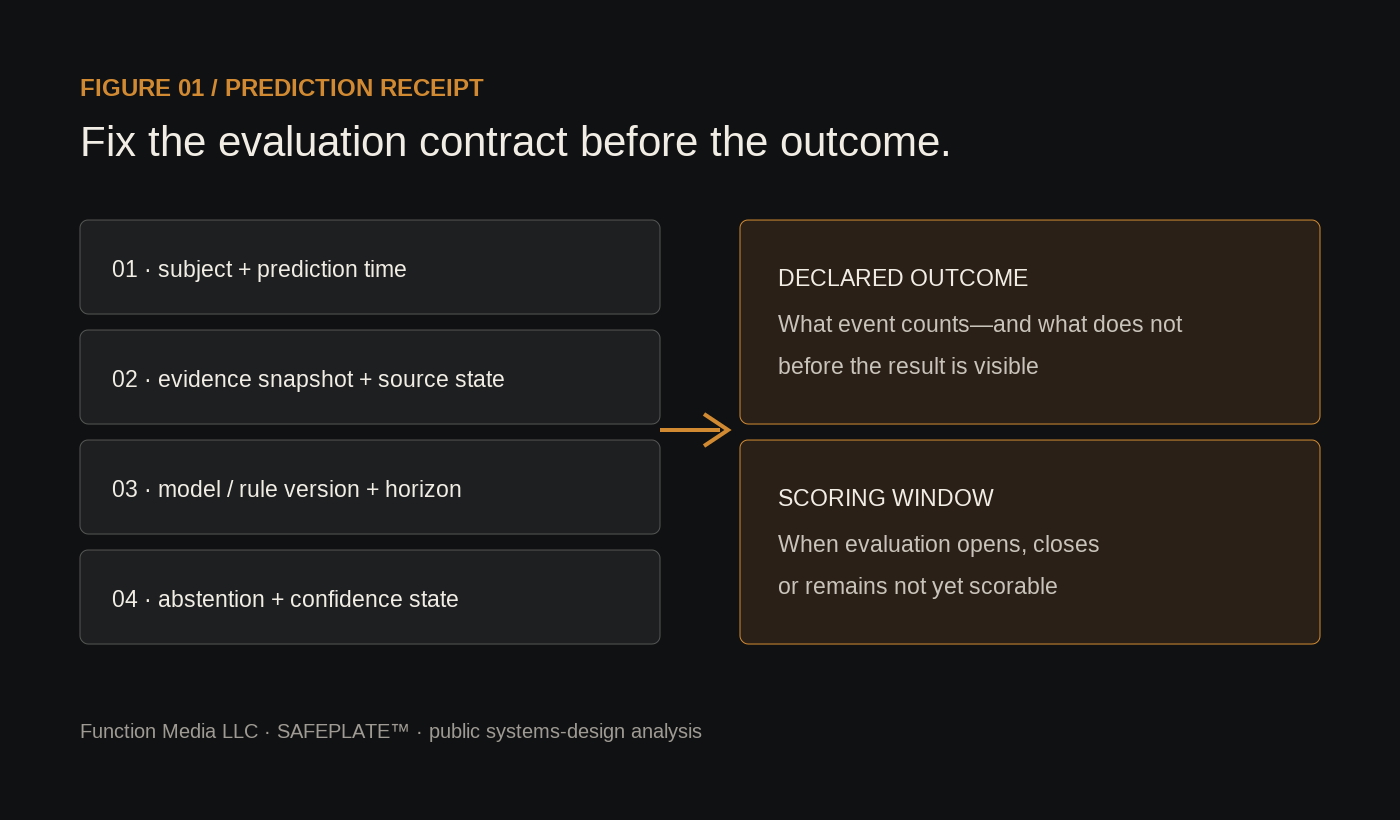
A defensible predictive workflow needs a scoring date: a declared point or interval when the original claim becomes eligible for comparison with a defined outcome. It also needs a prediction receipt that preserves the claim, subject, evidence snapshot, version and horizon before the outcome is known.
A score is a claim about a future state.
A predictive score is often displayed as if it were a current property of a facility, shipment, supplier or lot. In practice, it is a time-bound claim: given a particular evidence state, a defined method estimates the likelihood of a named outcome over a specified horizon.
Remove any one of those conditions and the number becomes ambiguous. A score of 0.72 might refer to an inspection finding within 30 days, a confirmed contamination event before distribution, a temperature excursion during one route, or a broader prioritization signal. Those are not interchangeable outcomes.
The scoring date forces the institution to state when enough evidence should exist to evaluate the claim. It prevents a prediction from remaining permanently “promising” because the evaluation window never closes.
Define success before the evidence can reward the definition.
Evaluation is strongest when the outcome and time window are fixed before the result is visible.
The prediction receipt is the minimum durable record.
A useful receipt should be created at prediction time and remain immutable. Later facts attach to it; they do not silently rewrite it.
The lot, facility, route, supplier, product, interval or other bounded unit to which the claim applies.
The exact time the claim was created, including the operational cutoff for included evidence.
The source versions, completeness state and known gaps available to the method at that moment.
The model, rule, threshold, feature or calibration version used to create the claim.
The event that counts as positive, negative, unknown or unscorable—and the source that establishes it.
The opening and closing conditions for evaluation, including delayed or censored outcomes.
Whether the method declined to predict, and why that case remains visible in the denominator.
Prediction, action and outcome are different events.
A high-risk prediction may cause an inspection, hold, test or review. That operational action is not itself proof that the predicted outcome occurred. Conversely, an intervention may prevent the outcome, which means a naïve evaluation could label the prediction “wrong” precisely because the institution acted on it.
The workflow should preserve three separate event streams.
The relationship between these streams matters. Evaluation policy may need to identify interventions, delayed outcomes, incomplete follow-up and cases where no reliable label can be established. Hiding those cases can make reported accuracy cleaner while making the system less honest.
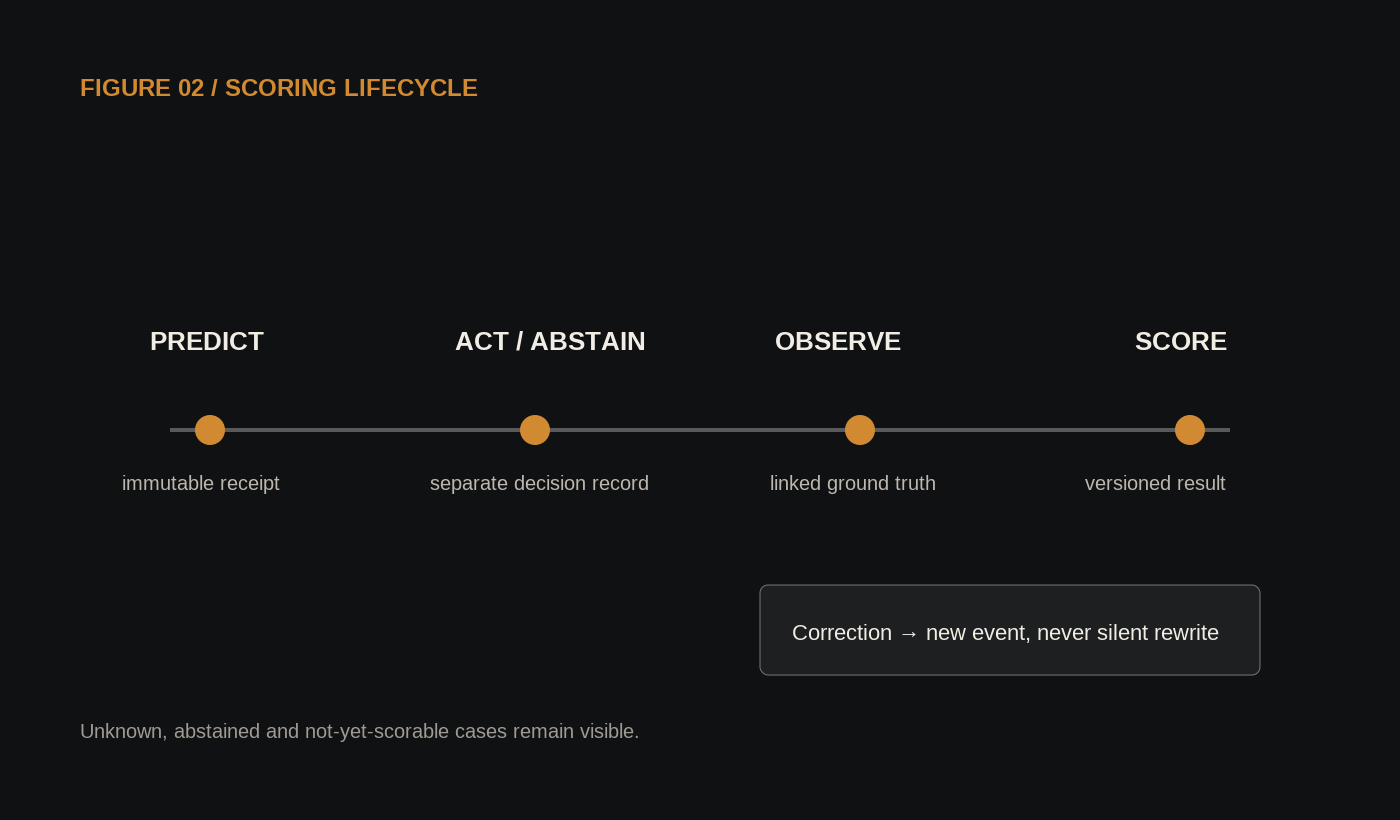
Ground truth arrives in layers.
Food-safety outcomes rarely appear as a single perfect label. Laboratory results can be corrected. Lot boundaries can expand. Inspection findings can be reclassified. Distribution records can arrive after an initial review. Root-cause analysis can reveal that an early signal described a different process or interval.
The answer is not to keep the original prediction editable. Preserve the receipt, then append outcome observations and corrections with their own timestamps, sources and provenance. A scoring event can identify which outcome version it used. If the outcome changes, a new scoring event can supersede the earlier one without erasing history.
This is consistent with a broader verification posture. FDA materials distinguish investigation, root-cause analysis and later verification activities, while FDA dashboards present data as tools for understanding patterns rather than substitutes for the underlying evidence. The important design move is to preserve how each conclusion was reached and when it became supportable.
The scoring window should be operationally explicit.
“Within 30 days” sounds precise until the workflow must decide when the clock starts, whether a shipment delay pauses it, which event closes it, and how to treat a case that leaves observation. A scoring window should therefore define its anchor, horizon, closure source, grace period and censoring rules.
For a facility-level prioritization claim, the anchor might be the prediction timestamp and the outcome a defined inspection finding during a later interval. For a shipment-level claim, the anchor might be dispatch and the outcome a verified excursion before receipt. For a lot-level claim, the relevant window may extend through a declared distribution or testing phase.
The exact definition is domain- and use-case-specific. The governance principle is stable: choose it before the result is known, version it, and report when a case cannot yet be scored.
Measurement belongs inside governance.
NIST’s AI Risk Management Framework Measure function calls for quantitative, qualitative or mixed-method assessment of AI risks and trustworthiness, with metrics appropriate to context and documented evaluation. The GAO AI Accountability Framework similarly organizes accountability around governance, data, performance and monitoring. These frameworks do not prescribe a SAFEPLATE™ implementation. They reinforce the public-control principle that performance claims need defined methods, documentation and continuing review.
Food-safety agencies also use data and predictive analytics to support prioritization and inspection work. That makes disciplined evaluation more important, not less. A useful system should be able to show what it predicted, what decision followed, which later evidence counted and which cases remained unresolved.
Report uncertainty without shrinking the denominator.
Performance summaries should keep abstained, unknown, delayed and unscorable cases visible. Otherwise a method can appear to improve by silently excluding the cases where evidence was weakest or follow-up was hardest.
A reviewable report should state the population, prediction period, outcome window, outcome definition, coverage rate, abstention rate, unresolved count, scoring version and any material intervention policy. Metrics can then be interpreted as properties of that declared evaluation set—not timeless properties of the system.
A design principle for SAFEPLATE™.
SAFEPLATE™ by Function Media LLC is being developed as an evidence-centered food-safety intelligence concept. The public design posture is that predictive or prioritization features should preserve temporal context, evidence provenance, declared outcomes and reviewable limits.
This article does not claim a deployed customer system, regulatory approval, certification, measured model performance or autonomous food-safety authority. It describes a systems-design principle: a prediction should become a durable, time-bounded claim that can later be evaluated without moving the target.