
Operational systems are very good at finding things that move together. The hard question begins after the match: can the system reconstruct the life of each input without confusing the strength of a relationship with the integrity of the evidence?
Correlation is an analytic relationship. It can describe co-occurrence, similarity, sequence, shared location, statistical association or a model-generated link. Chain of custody is a control record. It explains origin, possession, transformation, access, transfer, review and present state. The two can support one another, but they answer different questions.
This distinction matters wherever a screen compresses many source systems into one operational picture. A relationship score can be high while one input has an uncertain clock, an undocumented transformation or a missing handoff. A low-friction interface can make those weaknesses nearly invisible. The screen may look integrated even when the evidence is not.
The match and the record travel on different rails
Consider two observations that appear to describe the same event. One is generated by a sensor. The other arrives as an analyst note derived from a third-party report. A correlation engine may link them because their time, place and subject features align. That link is useful: it tells a reviewer where to look.
But the link does not establish that both observations are authentic, independent or complete. It does not show whether the analyst note paraphrased the third-party report correctly. It does not preserve the model version that generated the similarity score. It does not identify who accepted the match, what threshold applied, or whether a later correction invalidated one branch.
Keep each observation addressable as its own entity. Do not collapse two sources into one record just because they correlate.
Record collection, normalization, translation, enrichment, scoring, review and release as distinct activities with time and version.
Bind automated and human actions to accountable agents and declared roles without implying more authority than the record supports.
Express what used what, what generated what, and which later entity supersedes—not silently overwrites—an earlier one.
NIST describes provenance in terms of chronology, origin, ownership, location and changes to systems and associated data. Its audit guidance emphasizes event type, time, place, source, outcome and associated identities. W3C PROV separates entities, activities and agents, and provides relationships for usage, generation, derivation and responsibility. Together, these ideas point toward a design rule: preserve the evidence graph before presenting the analytic shortcut.
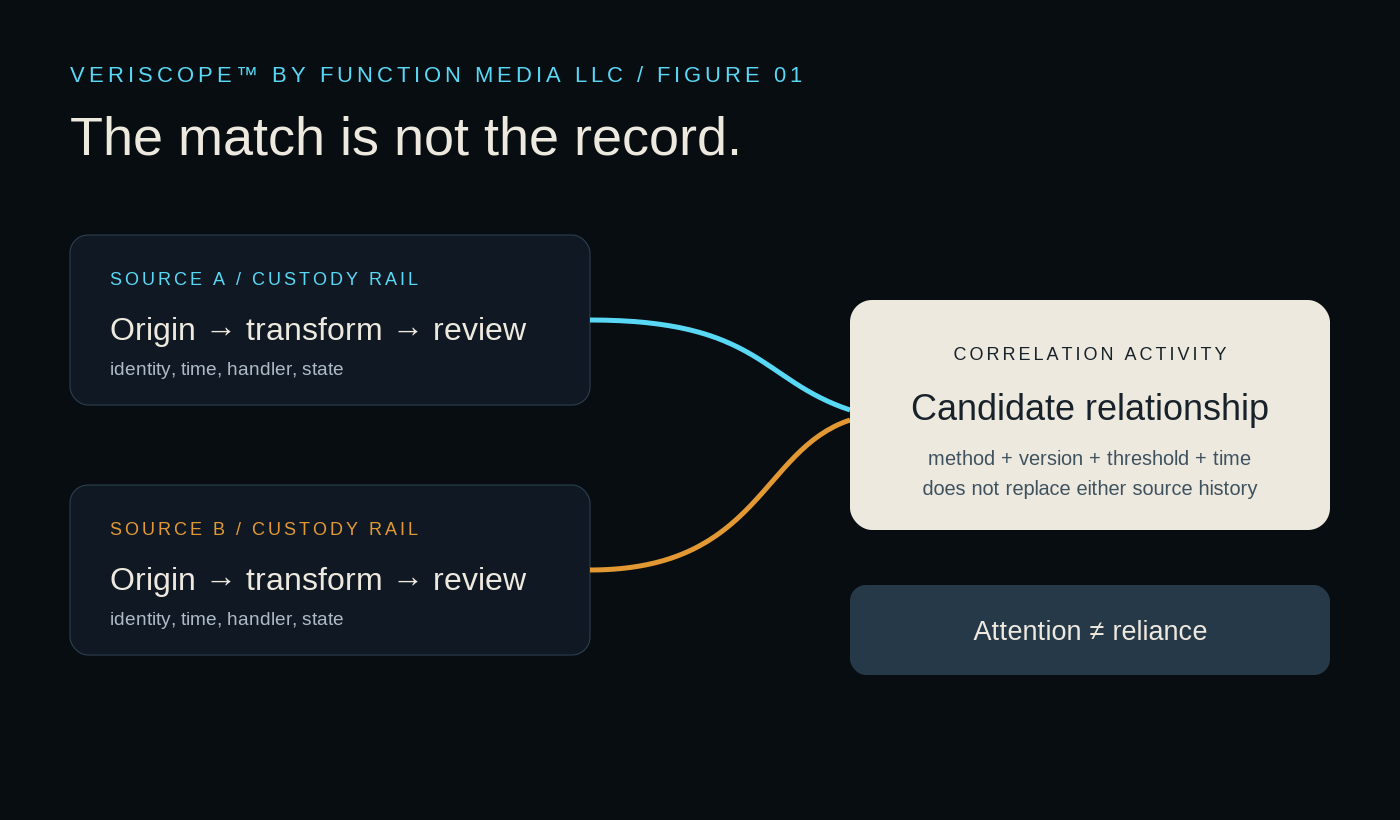
Correlation can justify attention. Custody must justify reliance.
The system should state which of those two jobs a result is performing.
What an evidence-bearing correlation should carry
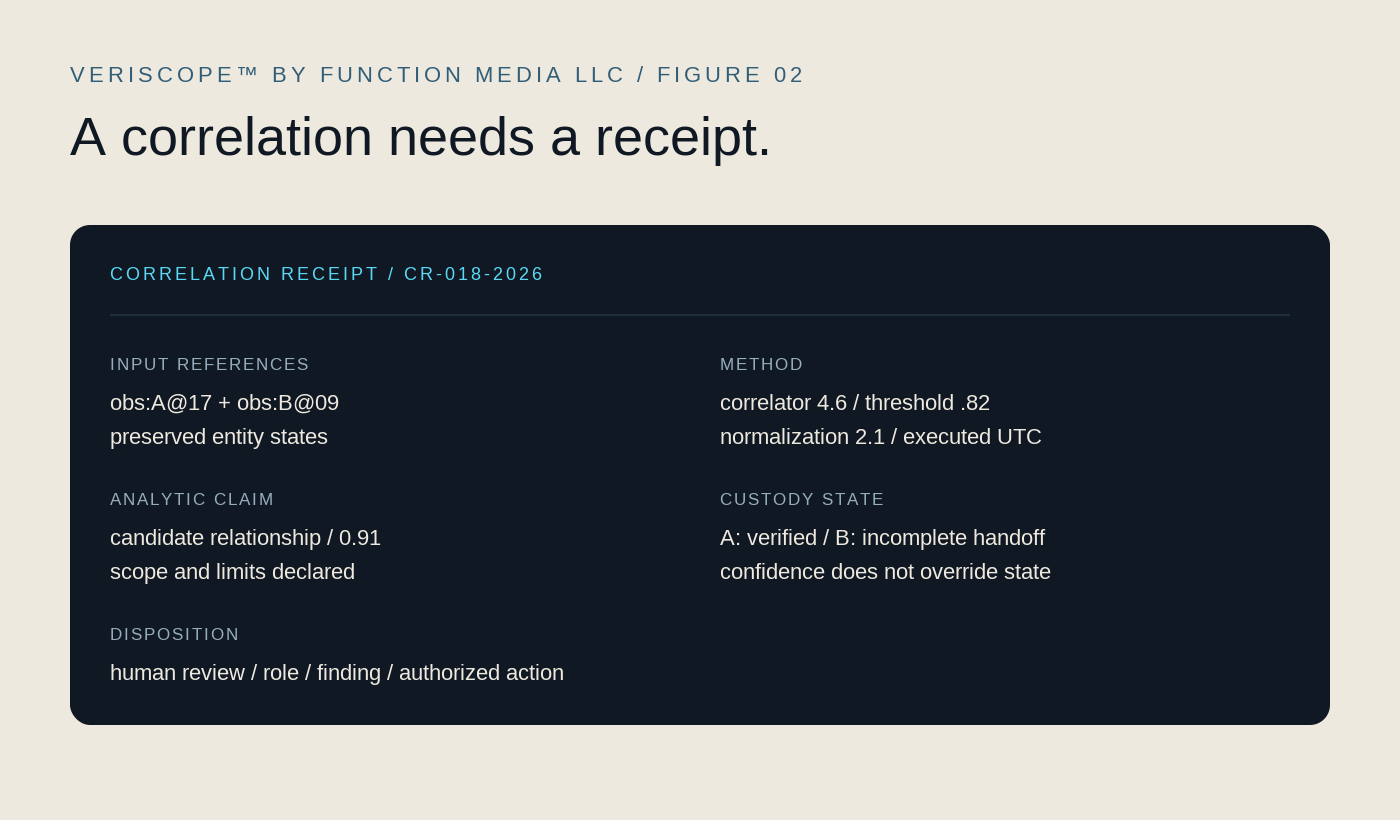
The answer is not to turn every result into an unreadable audit dump. It is to create a compact correlation receipt that points to the records needed for review. The receipt should be stable enough to cite, specific enough to reproduce, and honest about what remains unresolved.
Observation IDs, source systems, acquisition time, declared time basis and integrity state.
Feature set, normalization steps, model or rule version, threshold and execution time.
Who reviewed, the role they held, the finding they made, and what action—if any—was authorized.
A receipt should also distinguish confidence from custody. Confidence is a claim about the relationship. Custody is a claim about the record. If one source loses integrity, the system may preserve the historical correlation while marking it unsuitable for current action. That is better than deleting the relationship, because the change itself may matter during review.
When automated systems influence the result, provenance needs to include data sources, transformations, augmentations, labels, dependencies, constraints and metadata. NIST’s AI risk-management guidance treats that documentation as part of transparency. The practical implication is straightforward: “the model linked them” is not an adequate explanation. The record must identify which model, which inputs, which transformation path, which operating conditions and which accountable review.
The danger of the fused record
Many systems optimize for convenience by merging linked records into a single “golden” view. That can be useful for navigation, but it becomes dangerous when the merged view replaces the source identities. A correction then has nowhere precise to land. A reviewer cannot tell whether a field was observed, inferred, copied or manually selected. Confidence scores float free of the evidence that produced them.
The safer pattern is a composite view over preserved components. The interface may show one operational object, but the underlying model keeps the source observations, transformations, correlation activity and reviewer disposition separate. Each element has a stable identifier. Each change creates a new state. Each claim can be traced backward.
This also improves disagreement handling. Two records do not have to be forced into one truth prematurely. The system can represent a candidate match, conflicting attributes, unresolved identity, alternative hypotheses and a review deadline. Operational clarity does not require pretending uncertainty is gone.
Design for challenge, not just discovery
Search and correlation tools are usually demonstrated by how quickly they surface a useful connection. A stronger test is how well the system behaves when someone challenges that connection six months later.
- Can the original observations still be opened in their preserved states?
- Can the exact transformation and scoring versions be reconstructed?
- Can the system show which fields were observed, derived or asserted by a reviewer?
- Can a correction supersede a result without erasing the decision context in which the earlier result was used?
- Can access and handling history be reviewed without exposing protected content to unauthorized users?
If the answer is no, the system may be excellent at discovery and weak at accountability. That gap matters most when a correlation moves from a cue into a consequential action.
The operational standard
VERISCOPE™ by Function Media LLC is framed around evidence-centered operational intelligence: source identity, provenance, timing, review state and authority should remain visible as information is transformed into a decision aid. This field note is systems analysis, not a claim about a deployed customer implementation.
The standard is not that every signal must arrive perfect. Real operations contain missing fields, delayed records, conflicting clocks and uncertain identities. The standard is that the system should preserve those conditions, prevent correlation from laundering them into certainty, and make later review possible.
Correlation is indispensable. It helps institutions see relationships that isolated records conceal. But a relationship becomes operational evidence only when the system can also explain the life of the records underneath it.