Two systems record the same event. One says 09:14:22.410. The other says 09:14:21.930. A dashboard sorts the rows and presents a sequence. The result looks exact. It may still be false.
The first clock may have drifted. The second record may describe receipt time rather than event time. A network path may have delayed one message. A device may have corrected its clock after the observation. The records may be separated by less time than either source can measure reliably.
In an operational environment, sequence can change meaning. Which event happened first may affect escalation, attribution, maintenance, access review or the reconstruction of a failure. If an institution cannot explain the timing conditions behind its timeline, the timeline is a convenient arrangement—not yet a defensible evidence record.
Precision is not integrity.
Digital systems make time look authoritative. Milliseconds imply measurement. Uniform formatting implies comparability. A shared timezone implies alignment. None of those qualities proves that two clocks agreed when the records were created.
NIST’s log-management guidance identifies inconsistent timestamps as a direct obstacle to analysis across hosts. NIST security controls likewise treat timestamp granularity and relationship to UTC as defined system properties rather than decorative metadata. In operational technology, NIST states that common time is critical for event correlation and recommends monitoring the health of time sources themselves.
The practical lesson is simple: time is a source with health, configuration and failure modes. It should be governed like other evidence sources.
A trustworthy event needs more than one time.
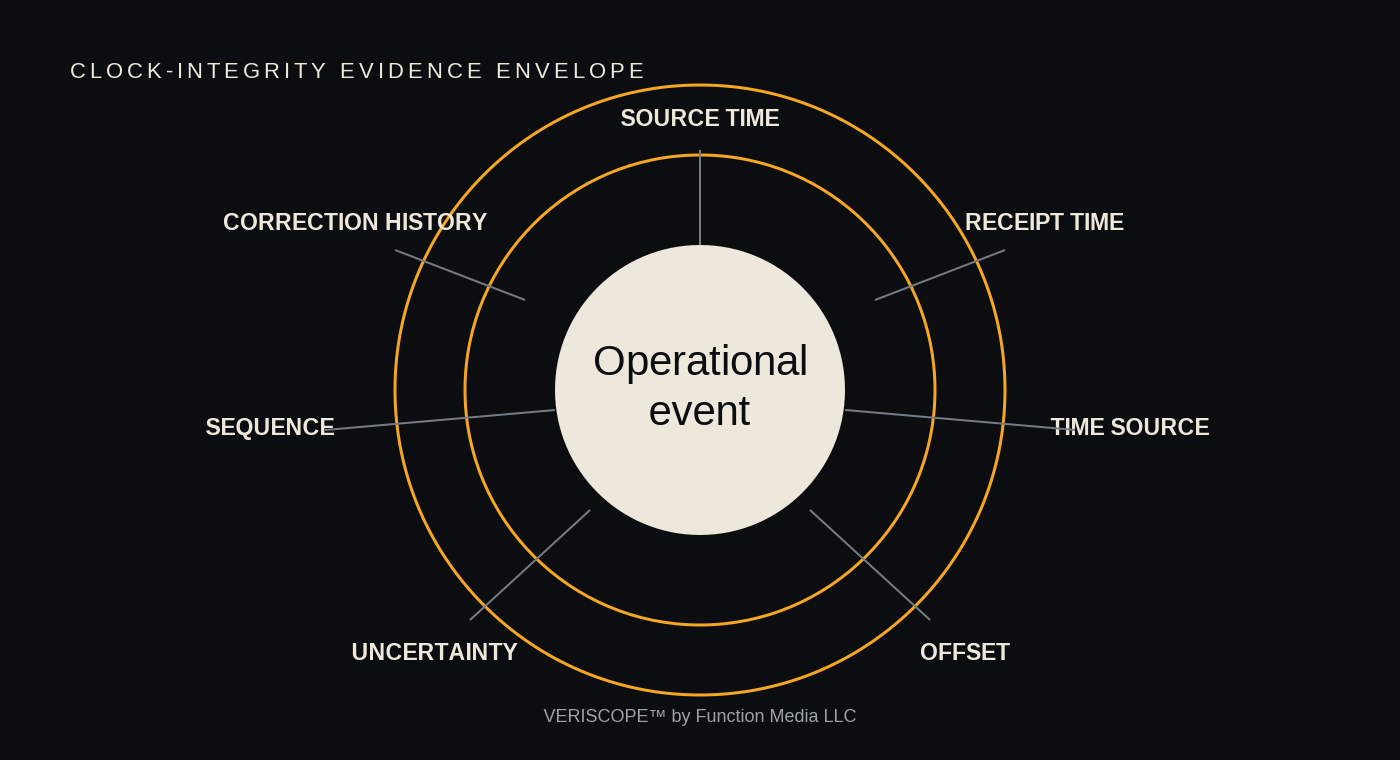
An evidence-centered record should preserve the source timestamp exactly as received. It should also record when the collector received the event, which clock or reference path the source relied on, the last known synchronization state, any observed offset and the uncertainty associated with that state.
This does not mean every record requires laboratory-grade timing. The required granularity depends on the decision. A maintenance workflow may tolerate seconds. A high-speed control system may require far tighter bounds. The system should make that requirement explicit and compare the available timing quality against it.
A useful event envelope therefore separates at least three questions:
- What did the source claim? Preserve the original observation without rewriting it.
- What can the institution infer about sequence? Use offsets, receipt times, counters and uncertainty bounds to test order.
- What action is authorized? Apply the institution’s threshold and human authority after the timing limits are visible.
Normalization must not erase the original.
Operational platforms often convert timestamps into a common timezone and sort them into a single timeline. That is useful, but normalization is an analytical transformation. It should never replace the original value or conceal the rule used to calculate the normalized time.
If a device was later found to be 1.4 seconds slow, the platform may recompute a comparison time. The record should still retain the source timestamp, the correction, who or what authorized it, the applicable clock-state observation and the version of the transformation logic. A reviewer should be able to move backward from the displayed sequence to the preserved event.
That separation also protects against false certainty. If the maximum error ranges overlap, the system should mark the order as unresolved rather than selecting a winner because one displayed value is smaller.
The disciplined system does not force every event into a total order.
It distinguishes what is known, what is bounded and what remains ambiguous.
Sequence can survive when clocks fail.
Clock time is not the only ordering signal. Monotonic counters, device sequence numbers, signed message chains, causal identifiers and application acknowledgments can preserve relationships even when wall-clock time is degraded.
Those signals answer narrower questions. A counter may establish that event B followed event A on one device without proving how either relates to an event on another system. A receipt timestamp may prove arrival order without proving occurrence order. A signed chain can protect integrity without establishing that the clock was correct.
VERISCOPE’s design direction is to retain these signals as separate evidence dimensions. Correlation should combine them, not collapse them into one unexplained confidence score.
The clock source is part of the attack surface.
Time can fail through ordinary drift, power loss, configuration errors, isolation, network delay or degraded reference sources. It can also be manipulated. The IETF’s Network Time Security standard adds authenticated time synchronization to help clients verify the identity and authenticity of time-service communications. NIST’s operational-technology guidance similarly recommends authenticated NTP or secure PTP where malicious modification is a concern.
Authentication does not remove every timing risk. Delay attacks can shift apparent time without changing packet content. Multiple sources can disagree. A secure reference may become unavailable. The system therefore needs health monitoring, fallback rules and visible degradation states rather than a binary “synchronized” badge.
Record time quality at the moment of observation.
A later health check cannot prove what the clock state was when the event occurred.
Keep the original and the normalized time.
Transformation should improve analysis without destroying provenance.
Use decision-specific tolerance.
The acceptable timing error depends on the operational consequence, not on a universal preference.
Allow unresolved order.
Ambiguity is a valid evidence state. Hiding it is a design failure.
The interface should expose the timing boundary.
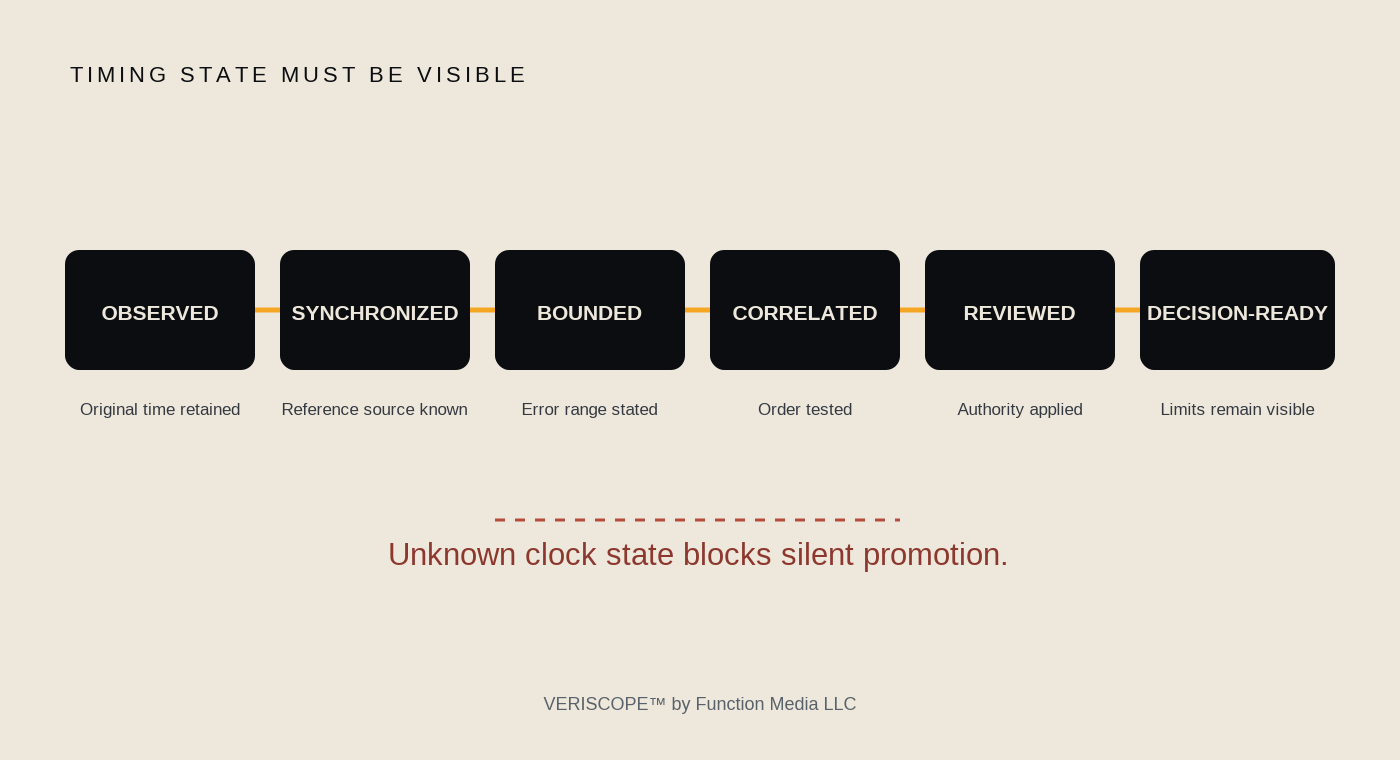
A reviewer does not need every protocol detail on the main screen. The interface does need to reveal whether the displayed sequence is observed, normalized, bounded or unresolved. It should make clock-health warnings visible, allow the reviewer to inspect original values and show which evidence established the order.
For a consequential event, the record should answer: Which time is being displayed? What source produced it? When was the source last verified? What offset and uncertainty applied? Was the value corrected? Which other signals support the sequence? What authority accepted the record for action?
A clean timeline is helpful. A reviewable timeline is trustworthy.
What VERISCOPE is being designed to support.
VERISCOPE™ by Function Media LLC is being developed as evidence-centered operational-intelligence infrastructure for complex environments. Its public design direction is to connect permitted signals, preserve provenance and uncertainty, surface disagreement and support accountable human review.
This field note describes a systems principle. It does not claim a customer deployment, government approval, certified timing performance, guaranteed outcome or autonomous decision authority. It does not disclose proprietary implementation methods.
The operating test is direct.
When two records disagree about order, can the institution show the original timestamps, receipt times, clock sources, offsets, uncertainty, correction history and the authority that accepted the resulting sequence?
If not, the system may have arranged the events. It has not yet established the timeline.